
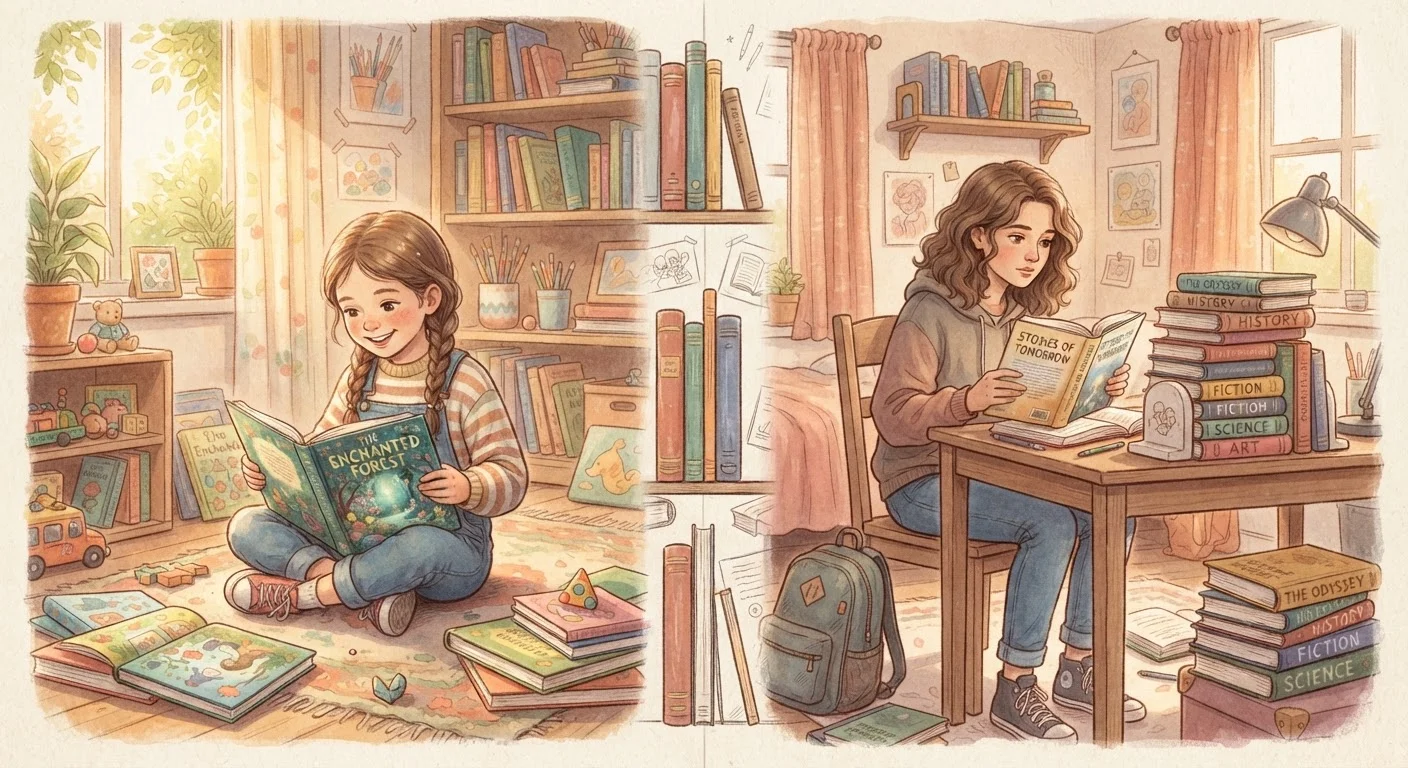
The Early Window: How Reading Habits Begin
The foundation of a lifelong reading habit is typically laid before a child reaches age 8. During these years, reading is still novel, and children who are read to by caregivers - or who have consistent access to books - begin associating reading with pleasure and safety rather than performance or obligation.
The critical shift researchers point to is sometimes called the 'third-grade pivot': around ages 8 to 9, children move from learning the mechanics of reading to using reading as a tool for learning and enjoyment. Children who arrive at this stage with strong fluency and a positive emotional association with books are far more likely to continue reading voluntarily. Those who struggle with decoding often develop an avoidant relationship with text that can persist for years.
Crucially, this early window is shaped not just by formal instruction but by modeling. Children who observe adults reading - for pleasure, not just utility - absorb a message that books are a normal, valued part of daily life.
53%
U.S. adults who read a book in the past year
According to Gallup polling, just over half of American adults report reading at least one book annually, a figure that has declined modestly over several decades.
Age 13
Common age when voluntary reading begins to decline
Research from the National Endowment for the Arts and reading motivation studies consistently identifies early adolescence as the inflection point for leisure reading drop-off.
3rd grade
Key developmental transition in reading
Educational researchers widely identify the shift from 'learning to read' to 'reading to learn' around third grade as a pivotal moment for long-term reading engagement.
Where the Habit Breaks: The Adolescent Drop-Off
For many readers, the middle school years mark the beginning of a slow withdrawal from voluntary reading. This pattern is well-documented in survey data from organizations like the National Endowment for the Arts and Pew Research Center, both of which show measurable declines in leisure reading frequency starting around age 13.
Several forces converge at this stage. Academic reading shifts toward assigned texts - often dense, unchosen, and assessed - which conditions teenagers to associate reading with obligation rather than discovery. At the same time, social life intensifies, screens multiply, and time becomes a genuinely scarce resource. For many teens, reading simply gets crowded out.
There is also an identity dimension that tends to get overlooked. Research in reading motivation suggests that adolescents who stop thinking of themselves as 'readers' disengage more completely than those who retain that self-concept - even when both groups have limited time. When school reading stops feeling personally relevant, the internal permission to read for pleasure can quietly dissolve. This is a pattern explored in depth in what quietly undermines a reading habit over time.
A child who was read to nightly by a parent develops a love of stories early and reads independently throughout elementary school.
A strong reader in fifth grade gradually stops picking up books for fun once middle school begins, finding assigned novels uninteresting and homework consuming.
A teenager who never considered herself a reader discovers a YA series through a friend's recommendation and reads the full series in a month.
A 35-year-old who rarely read after college begins a nightly reading routine after a period of high screen fatigue.
What Keeps Some Readers Engaged Through Adolescence
Not every teen disengages. Several conditions tend to sustain reading through the adolescent years. Autonomy over book selection is among the most consistently cited: teenagers who get to choose what they read - whether that's graphic novels, fan fiction, sports biographies, or genre fiction - maintain higher reading frequency than those restricted to curricular texts.
Genre fiction, and young adult fiction in particular, plays an underappreciated role here. YA novels speak directly to adolescent experience and have expanded dramatically in cultural reach over the past two decades. For many teens, finding a book that mirrors their life is the thing that saves their reading habit.
Peer communities also matter. Book clubs, online reading communities, and school programs that create social space around reading help adolescents maintain a reader identity during years when individual habits are most fragile. The social aspect of reading - sharing, recommending, discussing - can serve as a bridge when intrinsic motivation temporarily dips.
For Parents: Protect Reading Choice
One of the most effective things adults can do for a young reader is preserve their autonomy over book selection. Letting children and teens choose their own books - even if those choices seem light or repetitive - sustains the intrinsic motivation that structured school reading can erode. A book read by choice is almost always more impactful than one assigned.
Reading in Adulthood: Continuation, Loss, and Return
Adults who read regularly as children are statistically more likely to read as adults - but the relationship is far from absolute. Many people who drifted away from books in their teens find their way back in their twenties, thirties, or later, often triggered by a specific book, a life transition, or a deliberate effort to reclaim a quieter kind of attention.
For those who do maintain the habit, reading tends to deepen rather than simply continue. Adult readers often report greater selectivity, stronger genre preferences, and a more conscious relationship with time spent reading. The habit becomes a practice - something protected rather than assumed.
For those trying to understand the broader picture of who reads and how often, American reading habits by age and region offers a useful data-driven context. And for those curious why overall reading rates have shifted across generations, what the data shows about declining reading provides a measured look at long-term trends.
Understanding where the habit forms - and where it tends to fracture - is the first step toward either protecting it in younger readers or thoughtfully rebuilding it in yourself.