
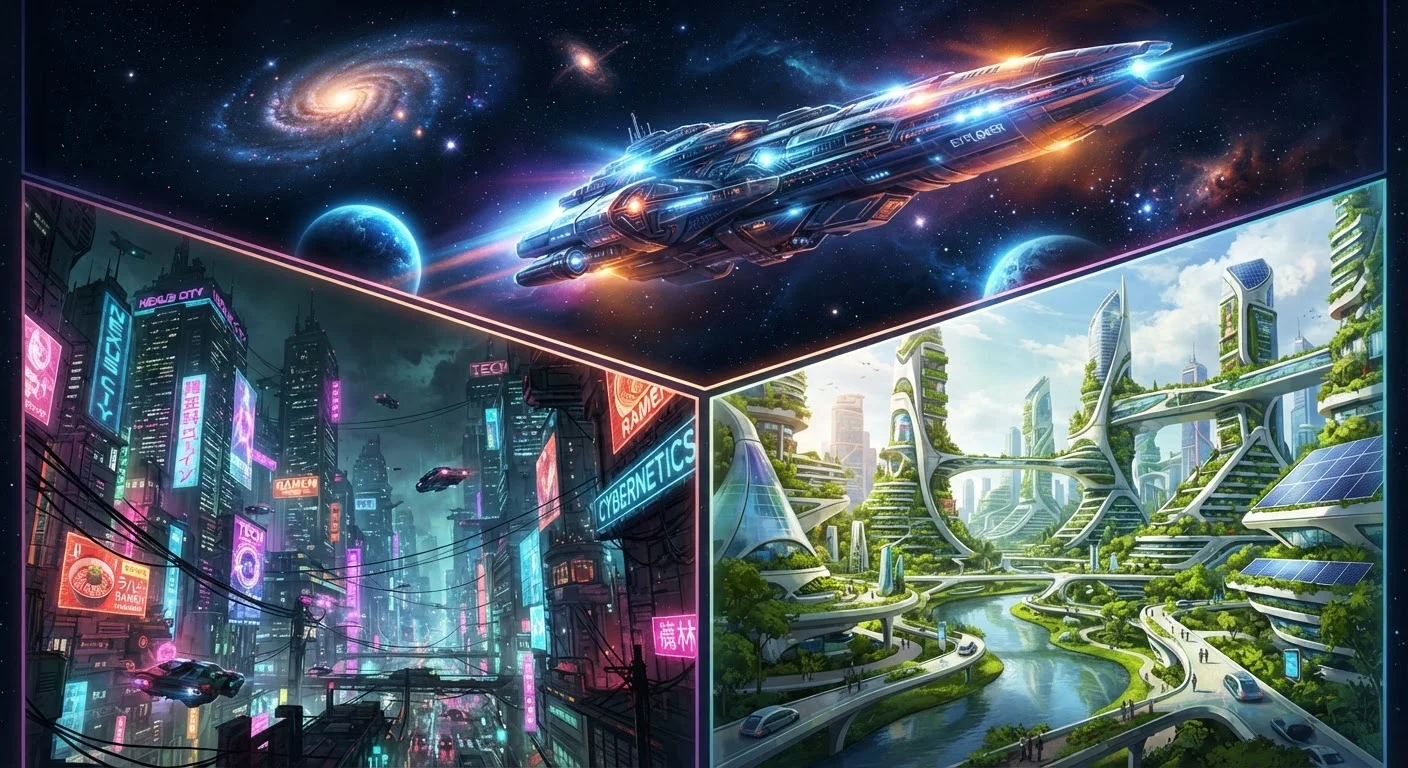
Science Fiction Is Not One Thing
Science fiction is one of the broadest categories in publishing - and one of the most frequently misunderstood. Readers who bounced off a dense near-future techno-thriller may not realize that a solar-powered utopian community novel and a military space epic also live under the same genre umbrella. The term covers an enormous range of approaches, aesthetics, and concerns.
Understanding the subgenres that make up science fiction is genuinely useful for readers. It helps explain why two books both shelved as sci-fi can feel almost nothing alike - and it makes it far easier to find the corner of the genre that suits your tastes. For a broader orientation to genre categories, see our overview of major book genres. If you're new to speculative fiction entirely, this guide for first-time readers is a useful place to begin.
Subgenres Overlap More Than They Divide
A novel can be simultaneously cyberpunk and dystopian, or blend hard sci-fi with space opera conventions. These categories are descriptive tools, not rigid containers. Many of the most celebrated science fiction works resist easy classification, drawing on multiple subgenre traditions to construct something distinctive. Treat subgenre labels as starting points for conversation, not definitive verdicts.
The Major Subgenres
Hard Science Fiction
Hard sci-fi holds scientific accuracy as its central value. Stories in this subgenre ground their speculative elements in real or plausible physics, biology, mathematics, and engineering. When a spacecraft travels between planets, the author accounts for orbital mechanics. When a pathogen spreads, the biology is rendered credibly.
This rigor doesn't make hard sci-fi dry - it creates a specific kind of tension rooted in the real constraints of the universe. Readers who enjoy puzzle-solving and technical depth often gravitate here. Works like Kim Stanley Robinson's Mars trilogy and Andy Weir's The Martian are frequently cited as touchstones of the form.
Hard sci-fi treats scientific plausibility as a moral commitment, not just a stylistic choice.
Space Opera
Space opera trades scientific precision for epic scale. Think galactic empires, interstellar conflict, and heroes facing civilization-defining stakes. The genre borrows its dramatic ambition from opera itself - grand emotion, sweeping narrative arcs, and a cast of characters whose choices reshape entire worlds.
Where hard sci-fi asks how, space opera asks what if on the largest canvas imaginable. The genre has enormous range: it can skew toward military action, political intrigue, or deeply character-driven storytelling. Ursula K. Le Guin's Hainish Cycle and Iain M. Banks's Culture series illustrate how thoughtfully constructed the subgenre can be.
Space opera asks what if on the largest canvas imaginable - entire civilizations are the stakes.
Cyberpunk
Cyberpunk emerged in the 1980s as a reaction to techno-optimism. Its signature setting is a near-future society where powerful technology coexists with deep social inequality - gleaming corporate towers looming over rain-soaked slums. The protagonists are typically hackers, criminals, or outcasts navigating systems designed to exclude them.
The subgenre's cultural fingerprint extends well beyond fiction into film, fashion, and gaming. William Gibson's Neuromancer is widely credited with defining the aesthetic, introducing concepts like cyberspace that shaped how people talked about networked computing for decades.
Cyberpunk imagines technology amplifying inequality rather than solving it - a warning dressed as a thrill.
Solarpunk
Solarpunk is in many ways cyberpunk's ideological counterpart. Rather than dystopia, it imagines futures where communities have reorganized society around ecological sustainability, mutual aid, and human flourishing. Technology is still central, but it serves collective wellbeing rather than corporate extraction.
The subgenre is relatively young and still actively defining itself through anthologies, short fiction, and online communities. Its optimism is considered a deliberate political act - an argument that hopeful futures are worth imagining and working toward. This makes it one of the more culturally distinctive voices in contemporary science fiction.
Solarpunk treats hopeful futures as a political act, not a naive fantasy.
Military Science Fiction
Military sci-fi centers on armed conflict in speculative settings, often examining the ethics of warfare, the psychology of soldiers, and the political machinery behind military institutions. The subgenre ranges from morally complex explorations of violence and duty to action-forward adventure narratives.
What distinguishes the best examples is an interest in the human cost of conflict - what service demands of individuals and what institutions do to ordinary people. Joe Haldeman's The Forever War, partly a response to the Vietnam era, remains one of the subgenre's most studied works.
Military sci-fi at its best is less about combat than about what war costs the people inside it.
Dystopian Fiction
Dystopian fiction imagines futures - or alternate presents - in which social, political, or environmental conditions have deteriorated dramatically, often under the weight of authoritarianism, surveillance, or ecological collapse. The subgenre functions as social critique: by exaggerating real tendencies, it makes them visible and urgent.
Dystopia has produced some of science fiction's most culturally resonant works, from George Orwell's Nineteen Eighty-Four to Margaret Atwood's The Handmaid's Tale. It remains one of the most widely read entry points into speculative fiction, partly because its concerns map so directly onto contemporary anxieties.
Dystopia exaggerates real social tendencies to make them impossible to ignore.
Biopunk and Climate Fiction
Two newer subgenres have grown in prominence alongside shifts in public concern. Biopunk focuses on genetic engineering, biotechnology, and the corporate or governmental control of biological systems - territory explored in novels like Paolo Bacigalupi's The Windup Girl. Climate fiction (sometimes called cli-fi) centers on ecological crisis, imagining futures shaped by rising seas, resource scarcity, and environmental upheaval.
Both subgenres use speculative extrapolation to engage with debates unfolding in real time. They demonstrate how science fiction continues to evolve - generating new subgenres as society confronts new categories of risk and possibility.
Biopunk and cli-fi show how science fiction generates new subgenres as society faces new categories of risk.
Start With What Already Interests You
If you're new to science fiction, your existing interests are a useful compass. Drawn to political history? Dystopian fiction and space opera often reward that instinct. Fascinated by biology or technology? Hard sci-fi or biopunk may be a natural fit. The subgenre framework gives you a way to match the kind of questions you find compelling to the stories most likely to engage them.
Finding Your Place in the Genre
Science fiction's subgenre diversity is a feature, not a flaw. It means the genre can accommodate readers who want rigorous extrapolation, those who want political allegory, and those who simply want a thrilling adventure set among the stars. The challenge is knowing where to look.
If you're considering branching into science fiction from another genre, this practical guide walks through how to find your footing without feeling overwhelmed. And if you want to think through whether a particular subgenre suits your reading habits before committing, these orienting questions can help you decide where your time is best spent.