What Data Brokers Are and How the Industry Works
Data brokers are businesses built on a simple premise: personal information has commercial value, and vast quantities of it are accessible. The industry encompasses hundreds of companies - from household names that run public people-search websites to behind-the-scenes firms that power targeted advertising and risk assessment tools.
Most people have never knowingly interacted with a data broker, yet nearly every U.S. adult has a profile held by at least one. The Federal Trade Commission has described the data broker industry as one that operates with limited transparency, collecting information on hundreds of millions of people without their direct knowledge.
Understanding this industry is a core part of understanding your digital privacy more broadly. For a fuller picture of how personal data moves through the internet, see The Internet's Full Picture: Digital Privacy A to Z.
4,000+
Estimated number of data broker companies operating in the U.S.
The Privacy Rights Clearinghouse and industry analysts have estimated the U.S. data broker sector includes several thousand active companies.
$300B+
Estimated annual global data broker market value
Industry research firms have placed the global value of the data brokerage and related information services market in the hundreds of billions of dollars annually.
~240M
U.S. adults with profiles in major broker databases
According to Federal Trade Commission reports and academic research, the largest data brokers hold profiles covering virtually the entire U.S. adult population.
Where Your Data Comes From
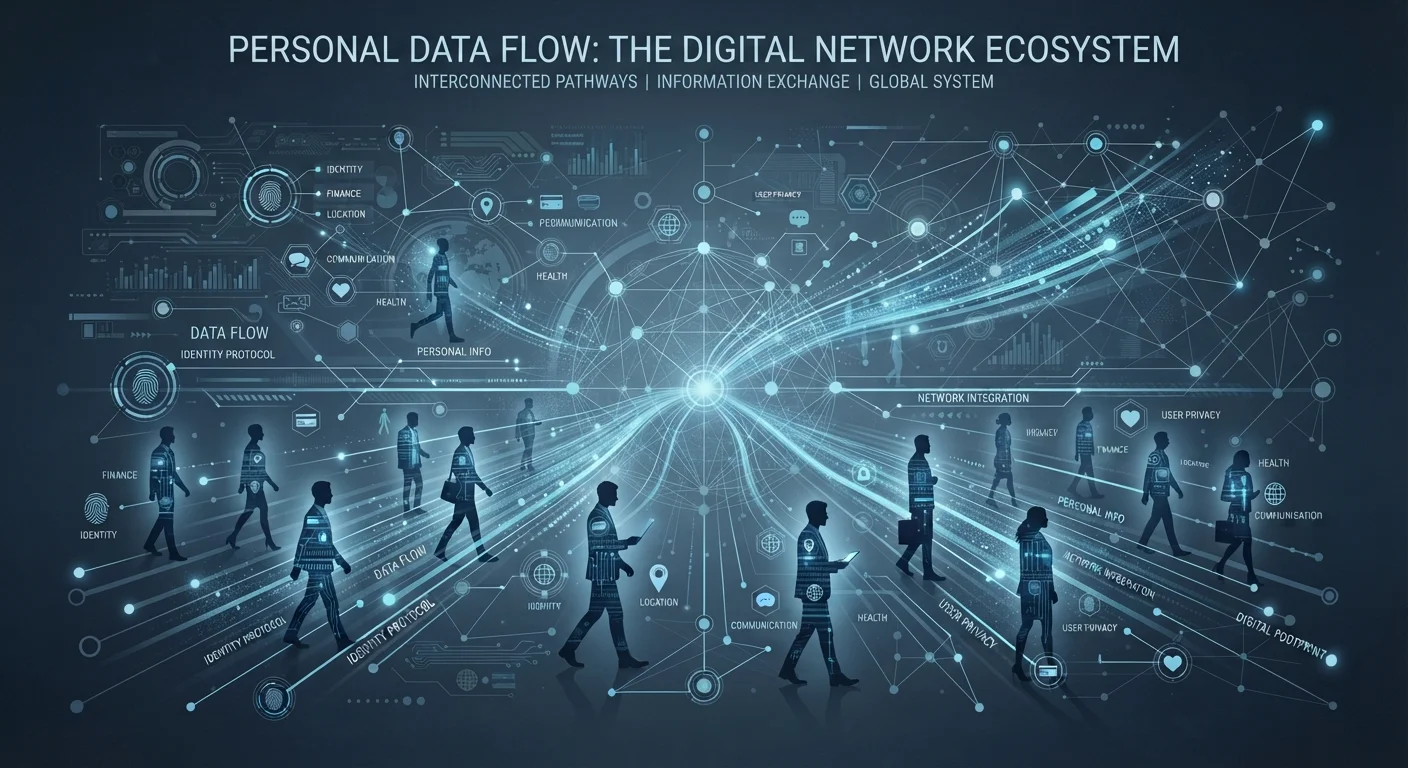
Data brokers draw from an enormous range of sources, most of which are either public records or data you've shared with other businesses that have sold it onward.
- Public records: Property deeds, voter registration rolls, court records, marriage and divorce filings, and business licenses are freely available and regularly ingested by brokers.
- Retail and loyalty programs: When you use a store loyalty card or sign up for a rewards program, your purchase history may be sold to third parties.
- Mobile apps: Many free apps collect and sell precise location data. A single app can share your movements with dozens of advertising and data partners.
- Social media: Publicly visible profile information, posts, and connections are scraped and incorporated into consumer profiles.
- Financial and insurance transactions: Mortgage applications, insurance inquiries, and credit applications generate data that can flow into broker pipelines through legal but little-known arrangements.
Brokers then merge these streams to build profiles that are more detailed than any single source would produce alone.
A person applies for health insurance and later notices ads for diabetes-related products appearing across different websites, despite never searching for such content.
A job seeker is passed over for a position, and when they ask why, the employer mentions information found through a background screening that the applicant doesn't recognize.
A woman moves to a new city to escape a difficult personal situation. Within weeks, she begins receiving mail at her new address from strangers, including one from her past.
A local government purchases aggregated location data from a data broker to analyze movement patterns during a public health event.
Who Buys Data Broker Information and Why
The customers of data brokers span a wide range of industries, each with different motivations.
Marketers and advertisers are the largest customer segment. Detailed consumer profiles allow them to target ads based on income estimates, health interests, political leanings, and purchasing behavior. This is the economic engine that funds most of the industry.
Insurance companies use data broker profiles to assess risk. In some documented cases, health-related purchasing data - such as buying certain foods or medications - has been factored into risk models.
Employers may use people-search services during background checks, supplementing formal screening with broader profile lookups.
Law enforcement and government agencies have increasingly purchased location and identity data from brokers, a practice that has drawn scrutiny from privacy advocates and members of Congress because it can circumvent traditional legal processes like warrant requirements.
Landlords and financial institutions also use broker data in tenant screening and credit decisioning, sometimes relying on data that the subject cannot easily review or dispute.
“Data brokers know more about us than our closest friends and family. They track our movements, our purchases, our online activities, and aggregate that into detailed profiles - often without our knowledge or consent.”
— Pam Dixon, Executive Director, World Privacy Forum
Your Rights and What You Can Do
Federal law in the United States offers limited protections specifically targeting data brokers. The Fair Credit Reporting Act covers credit reporting agencies but not the broader industry. The most meaningful rules have emerged at the state level.
California's Delete Act, signed in 2023, requires data brokers to register with the state and, by 2026, will mandate that a single opt-out request submitted to a state-run tool apply to all registered brokers. Vermont and Texas have their own broker registration requirements. Other states are actively considering similar legislation.
For individuals, practical steps include:
- Submitting opt-out requests directly to major data broker sites. The process varies by company and must often be repeated.
- Limiting what you share when signing up for loyalty programs and apps, and reviewing app permissions regularly.
- Checking privacy settings on social media accounts and restricting what is publicly visible.
- Being cautious about filling out forms, entering contests, or registering products online - these are common data collection touchpoints.
If you're new to thinking about online privacy more generally, this starter's overview of digital privacy covers foundational concepts and first steps. When joining any new online platform, it's also worth reviewing privacy steps to take before you sign up.
This article is for informational purposes only. Privacy laws vary by state and change frequently; consult a qualified legal professional for advice specific to your situation.