How the Electoral College Actually Works
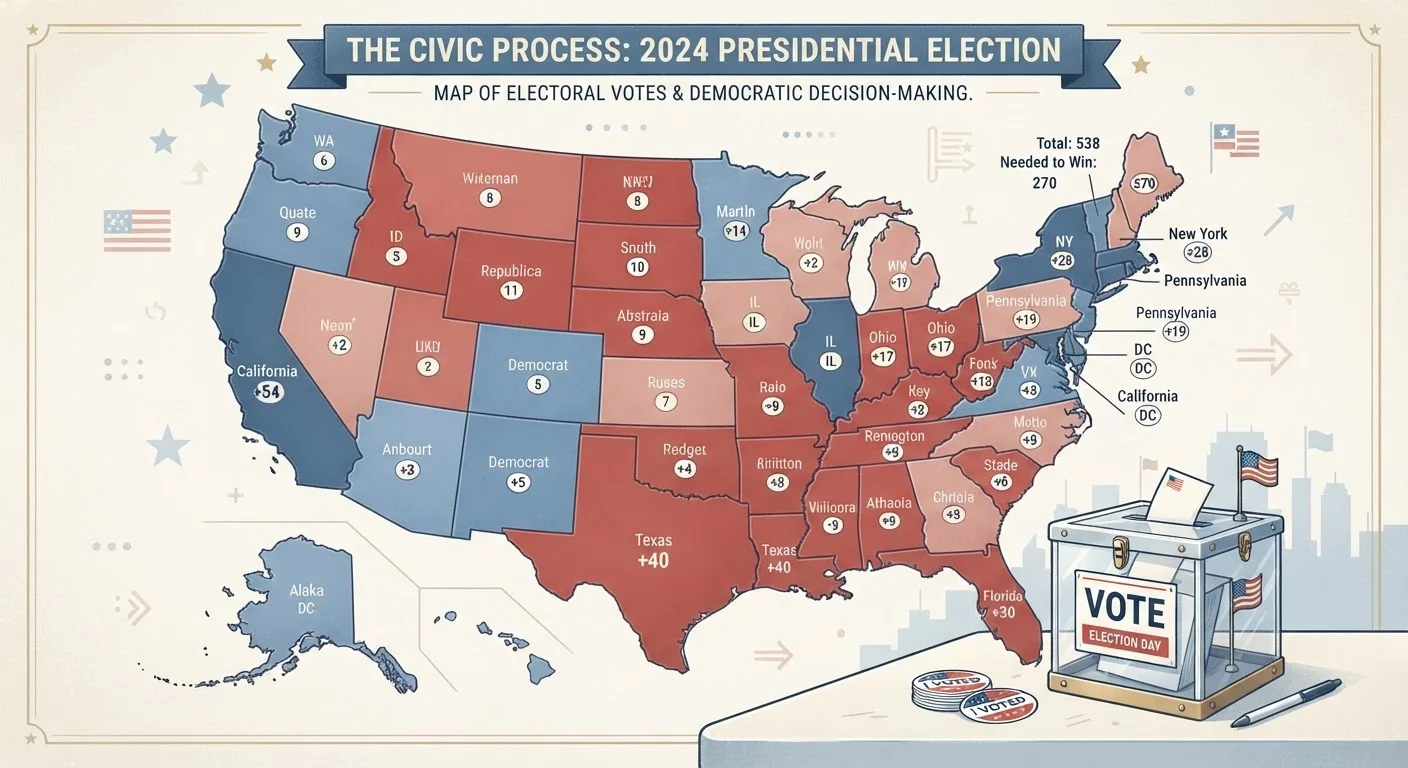
The Electoral College is the mechanism the U.S. Constitution established in Article II for electing the president. Each state receives a number of electors equal to its total congressional delegation - its House seats plus its two Senate seats. Washington, D.C. receives three electors under the 23rd Amendment. The total pool is 538 electors, and a candidate must secure at least 270 to win.
When voters cast ballots on Election Day, they are technically choosing a slate of electors pledged to their preferred candidate. In 48 states and D.C., the candidate who wins the state's popular vote receives all of that state's electoral votes - a winner-take-all rule established by state law, not the Constitution. Maine and Nebraska use a congressional district method that can split their electors.
Because electoral votes are not distributed purely by population, less populous states receive a proportionally larger share of electors relative to their population than the most populous states. A vote cast in Wyoming, for example, influences a larger share of the Electoral College than a vote cast in California, simply because every state has a guaranteed minimum of three electors regardless of population size.
| Criterion | Electoral College | National Popular Vote |
|---|---|---|
| Legal basis | U.S. Constitution, Article II | Would require amendment or interstate compact |
| Unit of measurement | State-level electoral votes | Individual ballots, nationwide |
| Winning threshold | 270 of 538 electors | Plurality of total national votes |
| Vote weight equality | Varies by state population | Equal regardless of state |
| Campaign strategy impact | Focuses effort on competitive states | Incentivizes broad national turnout |
| Historical divergences | Can differ from popular vote winner | Winner always has most individual votes |
| Current status | In effect for all presidential elections | Not currently in effect nationally |
How a National Popular Vote Would Work
Under a national popular vote system, every ballot cast across all 50 states and the District of Columbia would be added together into a single national tally. Whichever candidate received the most votes - a plurality - would win the presidency, regardless of how those votes were distributed geographically across states.
This system does not currently exist at the federal level. Implementing it would require either a constitutional amendment - which demands approval by two-thirds of both chambers of Congress and ratification by three-fourths of states - or the full adoption of the National Popular Vote Interstate Compact (NPVIC). The NPVIC is an agreement among states to award their electoral votes to the national popular vote winner once states totaling 270 or more electoral votes have joined. As of the mid-2020s, states totaling more than 200 electoral votes have joined the compact, but it has not yet reached the threshold needed to take effect.
For a deeper look at common misconceptions surrounding how votes are counted and certified, see our breakdown of persistent election myths.
270
Electoral votes needed to win presidency
Out of 538 total electors allocated among states and D.C. under current constitutional rules.
5
Presidents who lost the popular vote but won office
Occurring in 1824, 1876, 1888, 2000, and 2016, according to historical election records.
200+
Electoral votes represented in NPVIC states
States totaling over 200 electoral votes had joined the National Popular Vote Interstate Compact as of the mid-2020s, short of the 270 needed to activate it.
What Each System Measures - and Why It Matters
The core distinction between the two systems is what they are designed to measure. The Electoral College measures a candidate's ability to build winning coalitions across states, treating states as the fundamental political units. A candidate who dominates in a handful of large states can lose the Electoral College if they fail to compete effectively across a broader geographic range. This is why presidential campaigns concentrate heavily on competitive states - often called swing states or battleground states - rather than campaigning uniformly across the country.
A national popular vote, by contrast, measures aggregate individual preference. Every vote contributes equally to the national total regardless of the voter's state. Under this logic, a vote in Texas counts the same as a vote in Pennsylvania, and campaign strategy would shift toward maximizing turnout in vote-rich population centers regardless of geographic distribution.
Five times in U.S. history, these two systems have produced different outcomes - most recently in 2000, when George W. Bush won the Electoral College while Al Gore received more total popular votes, and in 2016, when Donald Trump won the Electoral College while Hillary Clinton received approximately 2.9 million more popular votes nationally. These divergences fuel ongoing public debate about which method more accurately reflects democratic will. Several claims repeated in that debate don't hold up to scrutiny - context matters when evaluating either system.
The Faithless Elector Question
Electors are generally expected to vote for the candidate who won their state's popular vote, but 'faithless electors' - those who vote differently - have occurred historically. In Chiafalo v. Washington (2020), the U.S. Supreme Court ruled that states may legally enforce elector pledges and penalize or replace faithless electors, significantly reducing this as a practical concern in modern elections.