How the US Government Is Structured
The United States operates under a system of federalism - meaning authority is divided between a national (federal) government and fifty state governments. The federal government itself is split into three branches designed to check each other's power.
The legislative branch - Congress - writes and passes federal laws. It has two chambers: the Senate (100 members, two per state) and the House of Representatives (435 members, apportioned by state population). The executive branch is led by the president, who enforces laws, commands the military, and conducts foreign policy. The judicial branch, headed by the Supreme Court, interprets whether laws and government actions comply with the Constitution.
States are not simply administrative units. They have their own constitutions, legislatures, governors, and court systems, and they control many decisions that touch daily life - from public schools to traffic laws.
Federalism
A system of government where power is shared between a national government and state governments, each with their own areas of authority.
Electoral College
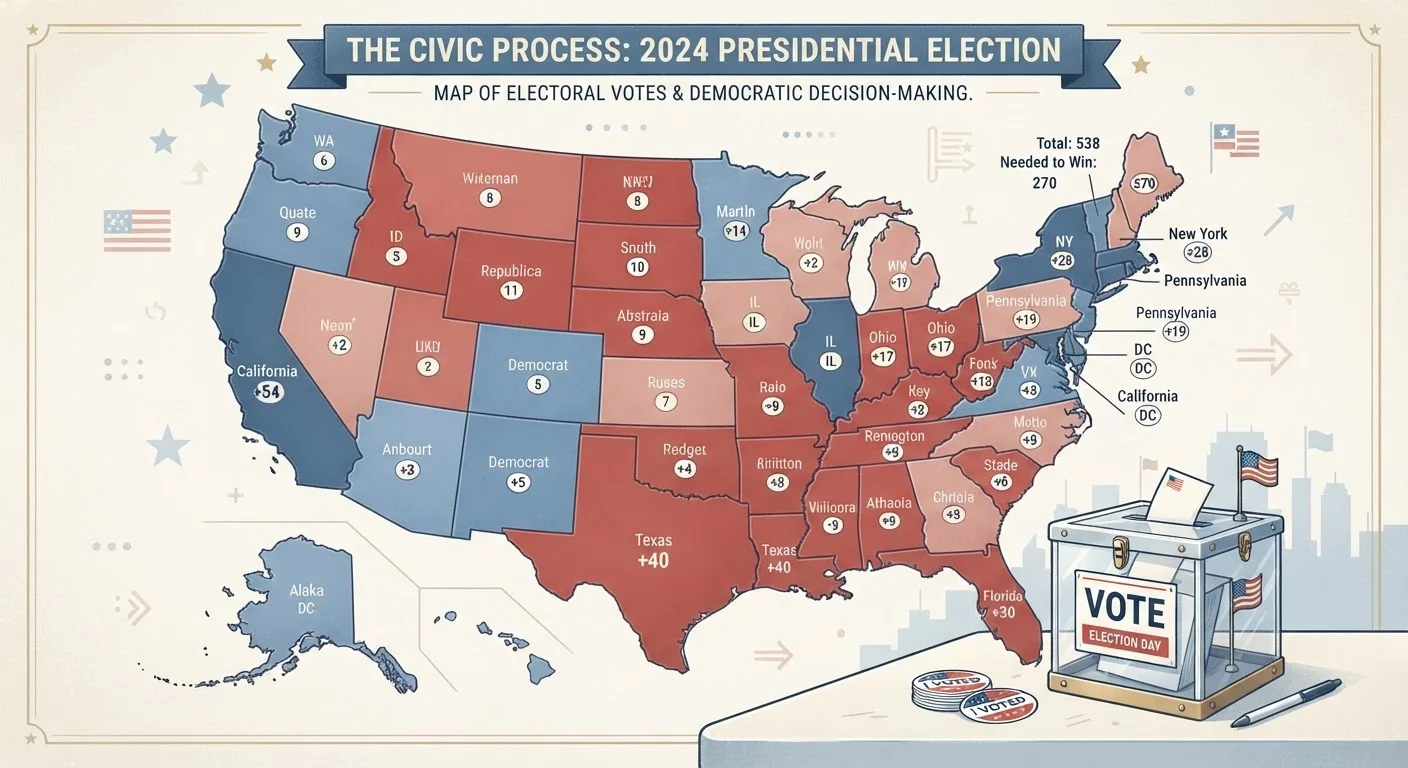
The body of 538 electors who formally elect the US president; a candidate must earn at least 270 electoral votes to win.
Primary election
An election held within a political party to choose which candidate will represent that party in the general election.
Filibuster
A Senate tactic where extended debate is used to delay or block a bill from coming to a final vote.
Cloture
A Senate vote - requiring 60 of 100 senators - that ends debate and allows a bill to proceed to a final vote.
Winner-take-all voting
An election format where the candidate with the most votes wins the entire seat, regardless of whether they received a majority.
Elections: Primaries, Generals, and Midterms
American elections happen in stages. A primary election is an intra-party contest: registered voters (rules vary by state) choose which candidate will represent their party in the main race. Primary voters tend to skew toward more engaged partisans, which can pull nominees toward the ideological edges of each party.
The general election is the main event - typically held on the first Tuesday after the first Monday in November in even-numbered years. For the presidency, voters technically cast ballots for a slate of electors who then vote in the Electoral College; a candidate needs 270 of 538 electoral votes to win.
Midterm elections fall two years into a presidential term. All 435 House seats and roughly one-third of Senate seats are contested, along with many governorships and state offices. Historically, the president's party tends to lose House seats in midterms, making them a significant check on executive power.
Check Your State's Primary Rules
Primary election rules vary significantly by state. Some states hold "open" primaries where any registered voter can participate regardless of party. Others hold "closed" primaries limited to registered party members. A few use caucuses or ranked-choice formats. Checking your state election authority's website before a primary will clarify exactly how your state handles the process.
The Two-Party System and Its Mechanics
The United States has two dominant parties: the Democratic Party and the Republican Party. This arrangement is not guaranteed by the Constitution - it flows largely from structural rules. Most American elections use winner-take-all (also called plurality or first-past-the-post) voting, where only one candidate wins regardless of vote share. Under this system, votes cast for a third-party candidate rarely affect who wins the seat, which discourages voters from backing parties outside the two majors.
Ballot access laws also place significant hurdles on smaller parties seeking to appear on state ballots. Our overview of why third parties struggle to break through explores these barriers in greater depth.
Within each major party, factions exist and matter. "Moderate" and "progressive" wings of the Democratic Party, or "establishment" and "populist" wings of the Republican Party, often compete in primaries and shape the direction of their caucuses in Congress.
Congress in Action: Legislation and the Filibuster
For a bill to become federal law, it must pass both the House and the Senate in identical form, then be signed by the president - or have a presidential veto overridden by a two-thirds majority in both chambers. The process involves committee review, floor debate, and amendment votes in each chamber.
In the Senate, the filibuster adds a major procedural layer. Because Senate rules permit unlimited debate by default, a senator can block a vote simply by refusing to yield the floor. Ending debate requires 60 votes for a procedure called cloture. In a closely divided Senate, this effectively means most legislation needs bipartisan support - 51 votes is rarely enough on its own.
For a deeper dive into the vocabulary surrounding these processes - from cloture to reconciliation - the US political terminology reference guide is a useful companion to this overview.
Budget Bills Are a Partial Exception
A Senate procedure called budget reconciliation allows certain fiscal legislation - bills directly affecting federal spending, revenue, or the debt ceiling - to pass with only 51 votes, bypassing the filibuster. This tool can only be used a limited number of times per year and must meet specific parliamentary rules, but it has been a major avenue for major legislation in recent decades.
Where to Go From Here
Following American politics becomes more manageable once you can identify the basic institutions and rules described above. The next step is building the habit of evaluating what you read. Our guide on reading political news without getting misled offers practical tools for assessing sources and spotting framing.
For readers interested in how US domestic politics connects to global events, understanding geopolitics provides a parallel foundation for following international news.
No single article can cover every mechanism in a system as layered as American governance. But knowing the three branches, how elections are staged, why two parties dominate, and how Congress passes - or fails to pass - legislation gives you a reliable scaffold for understanding nearly any political story you encounter.
USA.gov - How the US Government Works
The official US government portal provides plain-language explanations of federal agencies, the branches of government, and how to contact elected representatives.
Congress.gov
The official database for tracking US legislation, floor votes, committee activity, and the full text of bills - updated in near real time.
Ballotpedia
A nonpartisan encyclopedia covering elections, candidates, ballot measures, and state political institutions across all 50 states.