Why These Three Terms Are Not Interchangeable
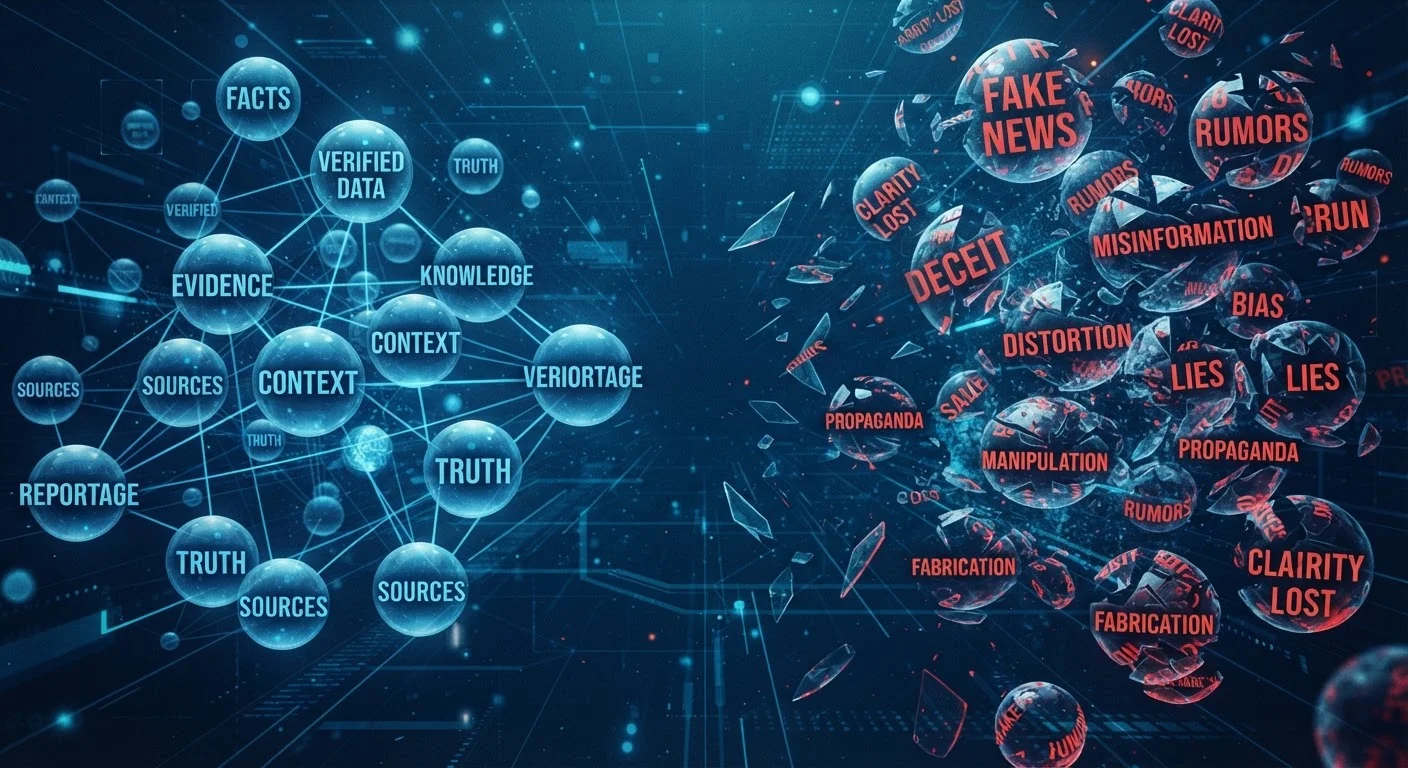
In everyday conversation - and even in news headlines - misinformation, disinformation, and malinformation are often lumped together under the umbrella of "fake news." That imprecision matters. Each term describes a distinct phenomenon with different causes, actors, and remedies. Treating them as synonyms makes it harder to diagnose the actual problem, let alone address it.
The framework distinguishing these three categories gained wide adoption through researchers at the Data & Society research institute and scholars such as Claire Wardle, who outlined it in work for First Draft, a now-dissolved research organization focused on information disorder. Policymakers across Europe and in parts of the U.S. government have since used this taxonomy when crafting responses to information threats.
Understanding the distinctions also makes you a sharper news reader. If you want to go deeper on what media literacy actually means, see what media literacy actually covers - it is broader than simply spotting false claims.
| Criterion | Misinformation | Disinformation |
|---|---|---|
| Accuracy | False or inaccurate | False, deliberately so |
| Intent to deceive | None - sharer believes it | Yes - core purpose |
| Origin | Errors, rumors, misunderstanding | Coordinated actors, propaganda |
| Who spreads it | Ordinary people, outlets in error | Bad actors + unwitting repeaters |
| Primary remedy | Education and correction | Platform policy, accountability |
| Malinformation comparison | Content is false | Content is false and intentional |
Misinformation: False But Not Malicious
Misinformation is inaccurate or false content shared by someone who does not know it is false. The person spreading it genuinely believes they are passing along truthful information. This can be a friend forwarding a debunked health claim, a social media user sharing an old photo mislabeled as recent, or an outlet repeating an unverified rumor before fact-checking it.
Intent is absent - but harm is not. Misinformation about medical treatments, election procedures, or emergency instructions can have serious real-world consequences even when no one meant to deceive. Because the sharer believes the content, they often advocate for it with conviction, lending it credibility it does not deserve.
Our cognitive architecture makes us especially vulnerable. Psychological research shows that emotionally resonant narratives frequently feel more convincing than dry, carefully reported facts - which helps explain why misinformation travels so efficiently on social platforms.
6x
Speed false news spreads vs. true news
A 2018 study published in Science by MIT researchers found false news stories spread roughly six times faster than accurate ones on Twitter.
70%
More likely to be retweeted - false stories
The same MIT study found false information was 70% more likely to be retweeted than accurate information, regardless of the account's follower count.
3 types
Information disorder categories defined by researchers
Scholars including Claire Wardle formalized the misinformation, disinformation, and malinformation taxonomy to give policymakers and researchers a shared vocabulary.
Disinformation: False and Intentional
Disinformation adds a deliberate layer. It is false content created and spread with the explicit purpose of deceiving an audience. The producers know the content is false - and that is precisely the point. Classic examples include fabricated quotes attributed to real politicians, manipulated images deployed during elections, and coordinated networks of fake accounts amplifying a false narrative.
Disinformation campaigns often exploit misinformation as a delivery mechanism: once a false story enters the information ecosystem through a credible-seeming source, ordinary users repeat it as misinformation - unaware of the original intent. This is one reason why disinformation is so difficult to contain after it has taken hold.
Recognizing disinformation requires asking not only "is this true?" but also "who benefits from people believing this, and why might someone have produced it?" That skeptical habit is part of what separates informed news consumers from those most susceptible to manipulation. The same critical lens applies to understanding how misleading headlines can distort an otherwise accurate story.
Malinformation: True, But Weaponized
Malinformation is the least familiar of the three categories and often the most surprising. It refers to accurate information that is shared in a way intended to cause harm. The content itself may be factually correct, but context is stripped away, timing is manipulated, or privacy is violated in order to damage an individual, group, or institution.
Examples include the deliberate leak of a private individual's personal details - commonly called doxxing - or the selective release of genuine but out-of-context communications designed to smear a public figure. Nation-state actors have used malinformation strategies by publishing hacked documents timed to maximum political disruption, even when the underlying documents are authentic.
This is why truth alone is not a sufficient defense against information harm. Intent and context determine whether accurate information serves the public interest or weaponizes it. For a parallel exercise in distinguishing terms that are frequently conflated in high-stakes coverage, consider how a coup, a revolution, and a civil war are routinely confused in headlines despite describing very different events.
A Note on the Term 'Fake News'
The phrase 'fake news' originally described fabricated content designed to deceive - closer to disinformation. Over time, it has been applied so broadly, and so politically, that researchers and journalists generally avoid it when precision matters. The three-part framework covered here offers a more useful analytical vocabulary. When you encounter 'fake news' in coverage, it is worth asking which specific category the speaker actually means.
Why the Distinction Matters for Everyday Readers
The practical value of this three-part framework is that it points toward different solutions. Misinformation calls for education, correction, and friction in sharing - helping people pause before they amplify something unverified. Disinformation demands structural responses: platform policies, investigative journalism, and sometimes legal accountability for coordinated deception. Malinformation requires norms around privacy, consent, and context - questions that sit at the intersection of journalism ethics and digital rights.
None of these problems is solved by simply labeling content "fake news." That phrase collapses important distinctions and has, in practice, become a rhetorical weapon used to dismiss legitimate reporting. Precise vocabulary is not pedantry - it is a prerequisite for clear thinking about one of the defining challenges of the current information environment.
You can also explore common myths about digital citizenship that shape how Americans navigate and misinterpret online spaces. And for a broader framework, understanding the different sections of a news site - reporting, opinion, analysis, and editorial - helps readers apply the right level of scrutiny to whatever they encounter.