The Brain's Preference for Story Over Fact
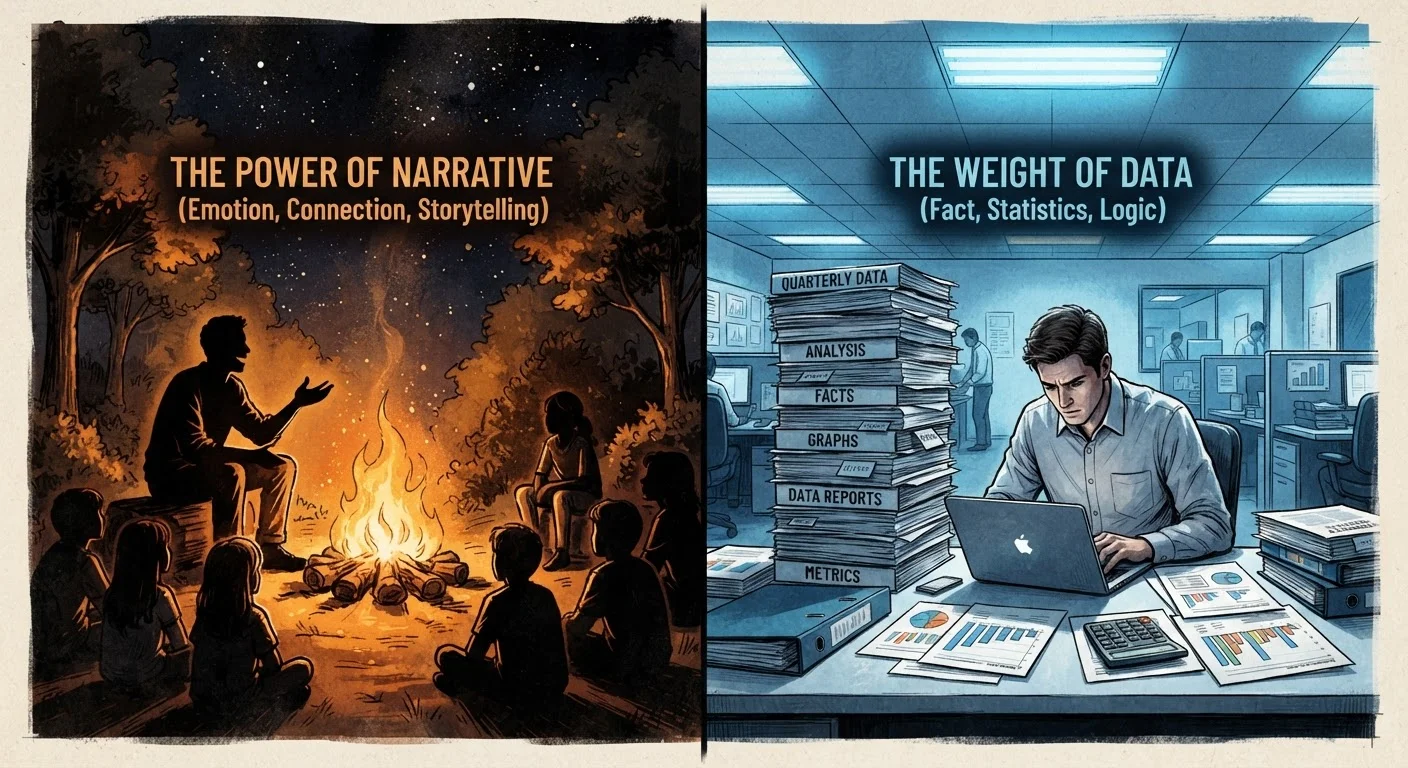
Long before written language existed, humans transmitted knowledge through stories. Anthropologists and cognitive scientists broadly agree that narrative is one of the oldest and most efficient formats for human communication. The brain doesn't treat a story the way it treats a spreadsheet - it maps the characters, motivations, and outcomes onto existing frameworks of meaning, making the information easier to encode and recall.
This processing difference has real consequences for how news and information land with audiences. A statistic - say, that a particular disease affects a certain percentage of the population - is abstract. A single named individual's account of living with that disease activates empathy, imagination, and memory simultaneously. Researchers sometimes call this the identifiable victim effect: the more concrete and personal a case, the more weight it carries emotionally.
That emotional weight is not a flaw in human cognition. It's adaptive. But it becomes a vulnerability when stories are constructed to mislead rather than inform. Understanding the difference between misinformation, disinformation, and malinformation is one useful framework for recognizing when narrative is being weaponized.
Narrative Bias Affects All Types of Content
This phenomenon isn't limited to political news. Sports reporting, health journalism, financial media, and even scientific communication are all subject to the same dynamics. Even sports statistics can mislead when packaged within a compelling but selective narrative. Any domain where stories are used to communicate information is susceptible.
Why Misinformation Often Tells a Better Story
Accurate reporting tends to be hedged. It acknowledges uncertainty, presents competing interpretations, and qualifies claims with sourcing. These are marks of journalistic integrity - but to a casual reader, they can feel like indecision or evasion. Misinformation, by contrast, tends to be clean, confident, and emotionally satisfying. It assigns clear villains and heroes, explains complicated events with simple causes, and confirms existing anxieties or beliefs.
This structural advantage is significant. A false narrative that fits neatly into someone's existing worldview will often feel more believable than a nuanced, factually accurate account that complicates that worldview. Cognitive scientists call this confirmation bias - the tendency to favor information that aligns with what we already think is true.
Social media amplifies the problem. Platforms are designed to maximize engagement, and content that provokes a strong emotional reaction - outrage, fear, inspiration - typically spreads further and faster than content that simply informs. Algorithmic news feeds can create filter bubbles that reinforce a narrow slice of reality, making emotionally charged narratives feel like consensus.
6x
Speed at which false news spreads vs. true news online
A widely cited 2018 MIT study published in Science found false news stories spread faster and reached more people on Twitter than accurate ones.
~70%
Americans who say they have encountered online misinformation
Pew Research Center surveys have consistently found large majorities of U.S. adults report seeing made-up news online, though rates vary by platform and demographic.
The Role of Repetition and Familiarity
One of the more counterintuitive findings from psychological research is that simply hearing a claim multiple times increases the likelihood that a person will rate it as true - even if they were previously told it was false. This illusory truth effect helps explain why coordinated misinformation campaigns prioritize volume and repetition over subtlety.
The effect is compounded by source amnesia: people often remember a claim long after they've forgotten where they first encountered it. A story shared by an unreliable social media account can, after sufficient repetition, feel as familiar and credible as something read in a trusted publication.
Headline design plays a role here too. Misleading headlines can distort an otherwise accurate story, and because most people read headlines without clicking through, a false impression can stick even if the article beneath it tells a different story.
Building Habits That Slow the Story Down
Awareness of these mechanisms doesn't make anyone immune to them, but it does create an opportunity to pause before reacting. Media literacy educators and researchers consistently recommend a handful of concrete habits for readers trying to navigate a high-volume, narrative-saturated information environment.
- Check the source before the content. Who published this? What is their track record? Is there an editorial process in place?
- Notice your emotional reaction. Strong feelings - especially rapid outrage or validation - are a signal to slow down, not speed up.
- Look for the evidence behind the narrative. What specific, verifiable claims is this story making? Are those claims sourced?
- Read past the headline. Headlines are written to attract attention, not to fully represent the story they introduce.
For a more detailed approach to developing these skills, see practical habits for reading the news more critically. These habits won't eliminate the pull of a compelling narrative, but they introduce a layer of deliberate reasoning between exposure and belief.
“A good story is the enemy of a complicated truth. The brain wants resolution, and resolution is exactly what misinformation provides.”
— Dannagal Young, Political communications researcher and professor at the University of Delaware