
Legislative Process Terms
American lawmaking involves a dense vocabulary that can obscure what's actually happening. Below are definitions of the terms you'll encounter most often when following congressional news.
Understanding these terms makes it far easier to follow legislation as it moves - or stalls - through Congress. For a related reference covering how to evaluate the language used in political reporting itself, see our guide on reading political news without getting misled.
Why These Terms Matter in Coverage
Political reporters often use procedural terms without explanation, assuming reader familiarity. When a headline reads 'Bill dies in committee' or 'Senate invokes cloture,' it refers to specific, defined processes - not vague outcomes. Understanding these terms allows readers to evaluate what actually happened, rather than relying solely on a journalist's framing. For additional guidance on following political coverage critically, see our companion guide on reading political news without getting misled.
Electoral and Structural Terms
Beyond the legislative process, a separate set of terms governs elections, representation, and the structure of the US political system.
| Total US Senators | 100 (2 per state) (US Senate) |
| Total US House Members | 435 voting members (US House of Representatives) |
| Cloture vote threshold | 60 of 100 Senate votes (US Senate Rule XXII) |
| Simple majority threshold | 51 Senate votes or 218 House votes (US Constitution) |
| Redistricting cycle | Every 10 years, following the census (US Census Bureau) |
| Presidential veto override | Two-thirds majority in both chambers required (US Constitution, Article I) |
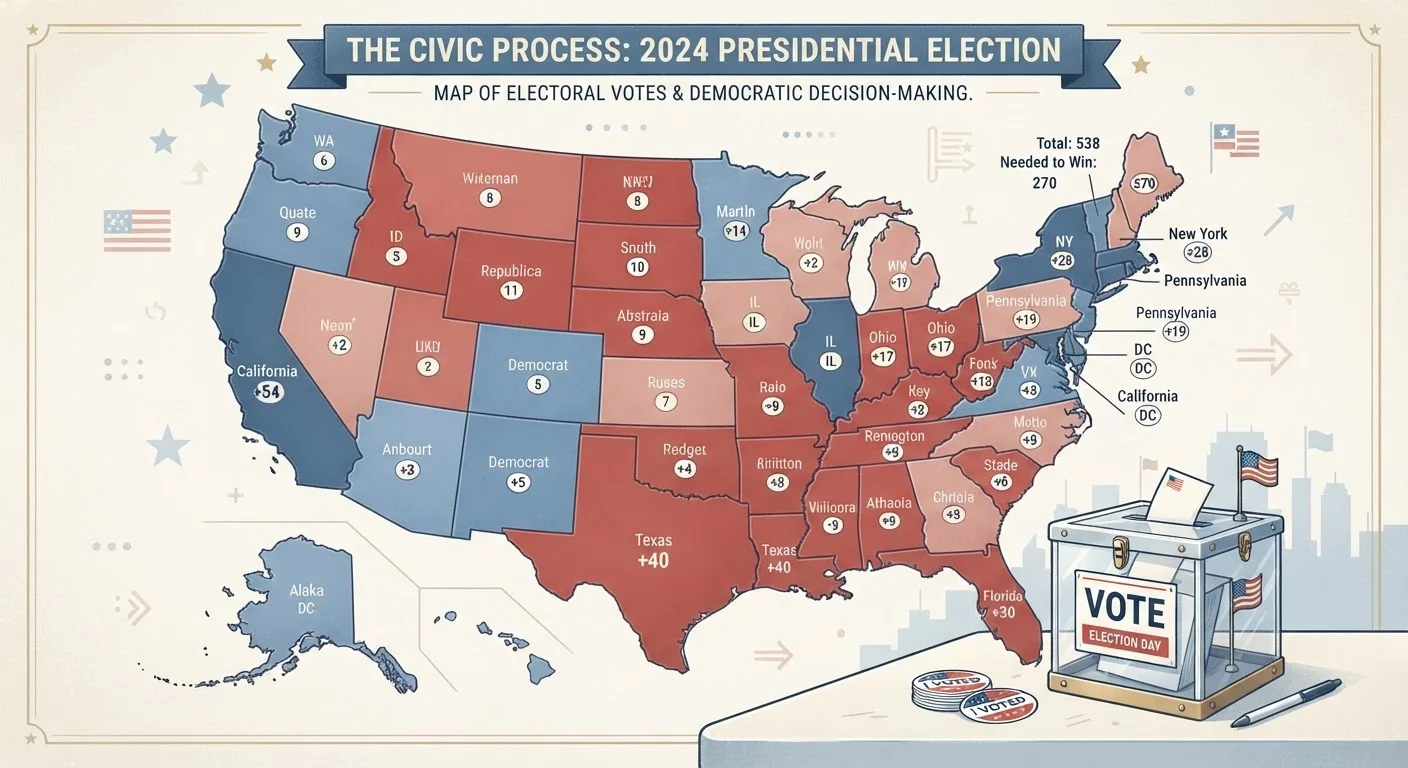
Electoral College: The system through which the president is formally elected. Each state is allocated a number of electors equal to its total congressional representation. A candidate must win 270 of 538 electoral votes to become president.
Redistricting is the process of redrawing congressional and state legislative district lines, typically following each decennial census. When these boundaries are drawn to benefit a particular party, the practice is called gerrymandering. For a deeper look at how this works and why it matters, see our explainer on redistricting and gerrymandering.
Primary election: A preliminary election in which voters within a party choose their candidate for the general election. Primaries can be open (any registered voter may participate) or closed (only registered party members may vote), depending on state rules.
Caucus has two meanings: it can refer to a group of legislators sharing a common identity or interest (such as the Congressional Black Caucus), or to a specific type of party nominating process held in some states in place of a traditional primary election.
If you find yourself also decoding the language used on platforms where political discussion happens, our glossary of online platform terms covers vocabulary from algorithms to content moderation. For international political terminology, see key terms in international news coverage.