What Redistricting Actually Does
Every decade, after the Census Bureau tallies the U.S. population, each state must redraw the boundaries of its congressional and state legislative districts. The goal is straightforward: districts should contain roughly equal numbers of people, reflecting where Americans have moved over the previous ten years.
The stakes are enormous. A congressional district's shape determines which neighborhoods and communities vote together - and therefore which candidates are likely to win. Because those maps govern elections for the entire following decade, whoever controls the drawing process holds significant structural power over political representation well into the future. For readers new to the fundamentals of American elections, our First-Timer's Overview of American Politics provides useful background context.
435
Total U.S. House seats reapportioned after each Census
Each state's seat count is recalculated based on population, meaning redistricting affects how much power each state holds in Congress for ten years.
~12
States using independent redistricting commissions
As of the most recent redistricting cycle, roughly a dozen states have shifted map-drawing authority away from legislatures, according to the National Conference of State Legislatures.
2019
Year federal courts lost jurisdiction over partisan gerrymandering
The Supreme Court's ruling in Rucho v. Common Cause closed the federal courthouse door to partisan gerrymandering claims, redirecting challenges to state courts.
How Gerrymandering Works in Practice
Gerrymandering describes the deliberate manipulation of district lines to produce a politically convenient outcome. The two classic techniques are known as packing and cracking. Packing means cramming as many of the opposing party's voters as possible into one or two districts, where they win huge margins but waste votes. Cracking means dividing those same voters across several districts so they never reach a majority in any of them.
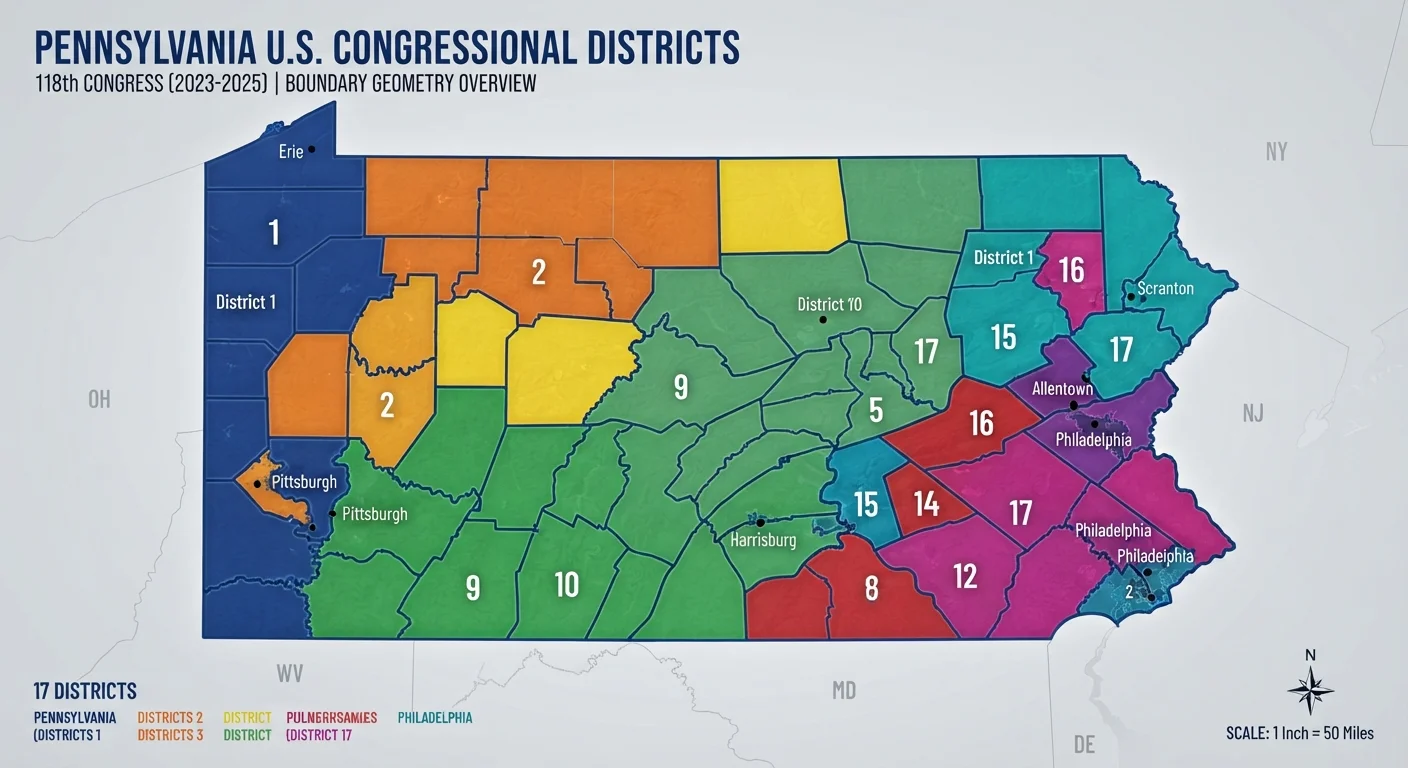
Used together, these methods can allow a party that wins, say, 55 percent of statewide votes to control 70 percent or more of the seats. The resulting district shapes are often irregular - long, winding, and seemingly arbitrary - because they are drawn around voter data rather than natural communities.
After the 2010 Census, North Carolina's Republican-controlled legislature drew congressional maps that critics said were designed to produce 10 Republican seats out of 13, despite the state's closely divided electorate.
Maryland's Democratic legislature drew the 6th Congressional District after 2010 to absorb Democratic-leaning Washington, D.C. suburbs, flipping a historically Republican rural seat.
California voters approved Proposition 11 in 2008, creating the California Citizens Redistricting Commission to draw state legislative maps instead of the legislature.
The Legal Landscape: What Courts Allow
Two distinct legal standards govern gerrymandering challenges. Racial gerrymandering - drawing lines specifically to dilute the voting strength of a racial or ethnic minority - is prohibited under the Voting Rights Act of 1965 and the 14th Amendment. Federal courts regularly review and, when necessary, strike down maps on these grounds.
Partisan gerrymandering operates in a different legal space. In its 2019 ruling in Rucho v. Common Cause, the U.S. Supreme Court held that federal courts cannot review claims of partisan gerrymandering, ruling it a political question beyond federal judicial reach. That decision pushed challengers toward state courts and state constitutions, where some have found more traction.
“The courts have no constitutionally grounded standard for adjudicating partisan gerrymandering claims, and we are not responsible for solving the problem of partisan gerrymandering. Excessive partisanship in districting leads to results that reasonably seem unjust. But the fact that such gerrymandering is 'unjust' does not mean it is unconstitutional.”
— Chief Justice John Roberts, U.S. Supreme Court Chief Justice, writing for the majority in Rucho v. Common Cause (2019)
Who Controls the Process - and Reform Efforts
In the majority of states, the legislature draws both congressional and state legislative maps. When one party controls the statehouse, it has near-total authority over the outcome - and an obvious incentive to favor itself. This structural conflict of interest is the core criticism of legislative redistricting.
Reform advocates have pushed for independent redistricting commissions as an alternative. These bodies, used in states including California, Arizona, Michigan, and Colorado, are composed of citizens rather than lawmakers. Members are typically screened to exclude lobbyists, recent candidates, and party officials. Research on their effectiveness is mixed, but proponents argue they reduce the most egregious partisan distortions.
Other proposed reforms include algorithmic map-drawing, which uses neutral mathematical criteria - compactness, community cohesion, and population equality - to generate district options without human political input. None of these approaches is universally adopted, and each has its own critics. For a broader glossary of terms that come up in redistricting debates, see our Plain-Language Political Terminology Guide.