A System Built on Distrust
When the Founders gathered in Philadelphia in 1787, their most pressing concern was not efficiency - it was safety. They had lived under a monarchy and fought a revolution over arbitrary power. The Constitution they produced reflects that fear: it is an architecture of suspicion, deliberately designed so that no single institution could govern alone.
James Madison captured the logic in Federalist No. 51: "Ambition must be made to counteract ambition." The solution was not to rely on virtuous leaders, but to build a structure where each branch would have both the motive and the means to resist the others. Tension, in this view, was not a problem to be solved - it was the point.
For readers looking for a broader foundation, this structured introduction to the US political system maps out how these institutions fit into the wider landscape of American democracy.
535
Total members of Congress
Congress comprises 100 senators (2 per state) and 435 House representatives apportioned by population, per the US Constitution.
9
Supreme Court justices
The Court has had nine justices since 1869; the Constitution sets no fixed number, leaving it to Congress to determine by statute.
1803
Year judicial review was established
The landmark case Marbury v. Madison gave federal courts the power to strike down laws that violate the Constitution.
What Each Branch Actually Does
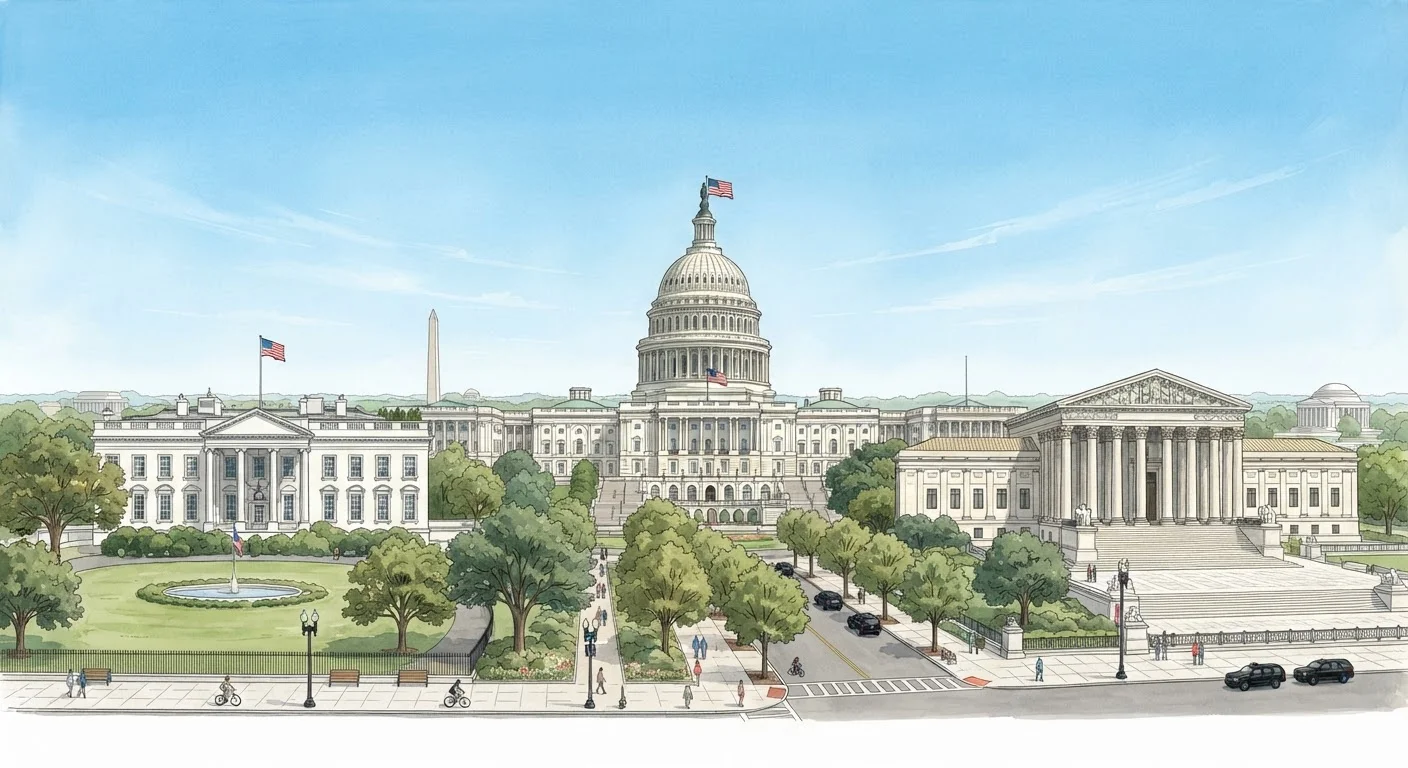
The Legislative Branch - Congress consists of the Senate and the House of Representatives. Its core power is writing and passing federal law. Congress also controls the federal budget, declares war, and confirms presidential appointments to federal courts and the Cabinet. The two chambers are not equal in all respects - the Senate holds distinct powers the House does not, including ratifying treaties and conducting impeachment trials.
The Executive Branch is headed by the President, who signs or vetoes legislation, commands the armed forces, conducts foreign policy, and oversees a vast network of federal agencies that implement laws day to day. The President does not write laws but shapes them through priorities, vetoes, and executive orders.
The Judicial Branch - anchored by the Supreme Court - interprets whether laws and executive actions comply with the Constitution. Federal judges are appointed for life, insulating them from electoral pressure and allowing them to rule against popular or politically powerful positions.
Congress passes a sweeping healthcare bill, but the President vetoes it, arguing it exceeds the federal government's authority.
A president signs an executive order restricting immigration. Multiple federal courts issue injunctions blocking enforcement, and the case eventually reaches the Supreme Court.
A president nominates a federal judge widely seen as unqualified. The Senate Judiciary Committee refuses to hold a confirmation hearing.
How Each Branch Checks the Others
The Constitution does not simply divide power - it creates overlapping authority so that each branch must cooperate with or confront the others to accomplish its goals.
- The President checks Congress by vetoing legislation. Congress can override that veto with a two-thirds majority in both chambers, which is rare but not unprecedented.
- Congress checks the President through the power of the purse, the Senate's confirmation role, and the impeachment process.
- The judiciary checks both by reviewing the constitutionality of laws and executive actions - a power known as judicial review, firmly established by Marbury v. Madison (1803).
- The President checks the judiciary indirectly through the appointment of federal judges, which requires Senate confirmation.
This web of dependencies means that major policy changes almost always require negotiation across institutional lines, slowing the pace of government but reducing the risk of unchecked action.
Follow the branch, not the person
When evaluating a political controversy, it helps to ask which branch is acting, which branch is responding, and what constitutional authority each is invoking. This framework cuts through partisan framing and anchors the debate in structural terms. Most major political disputes in the US reduce to a question of where one branch's authority ends and another's begins.
Why the Clash Is a Feature, Not a Bug
Americans often express frustration when Congress gridlocks, when the President issues orders that courts block, or when a judicial ruling overturns a popular law. But these moments of friction are precisely what the system was built to produce.
When branches clash, it typically means one institution is pushing against limits the Constitution placed on it - and another is enforcing those limits. A presidency constrained by courts, a Congress that must negotiate with the White House, a judiciary that cannot act without a case brought before it: these are not signs of a broken system. They are the system working as designed.
Understanding this structure also helps explain why third-party movements face such significant obstacles - the same institutional design that separates power also tends to reinforce the two-party duopoly. Third parties in American politics face structural barriers that go well beyond voter preference.