
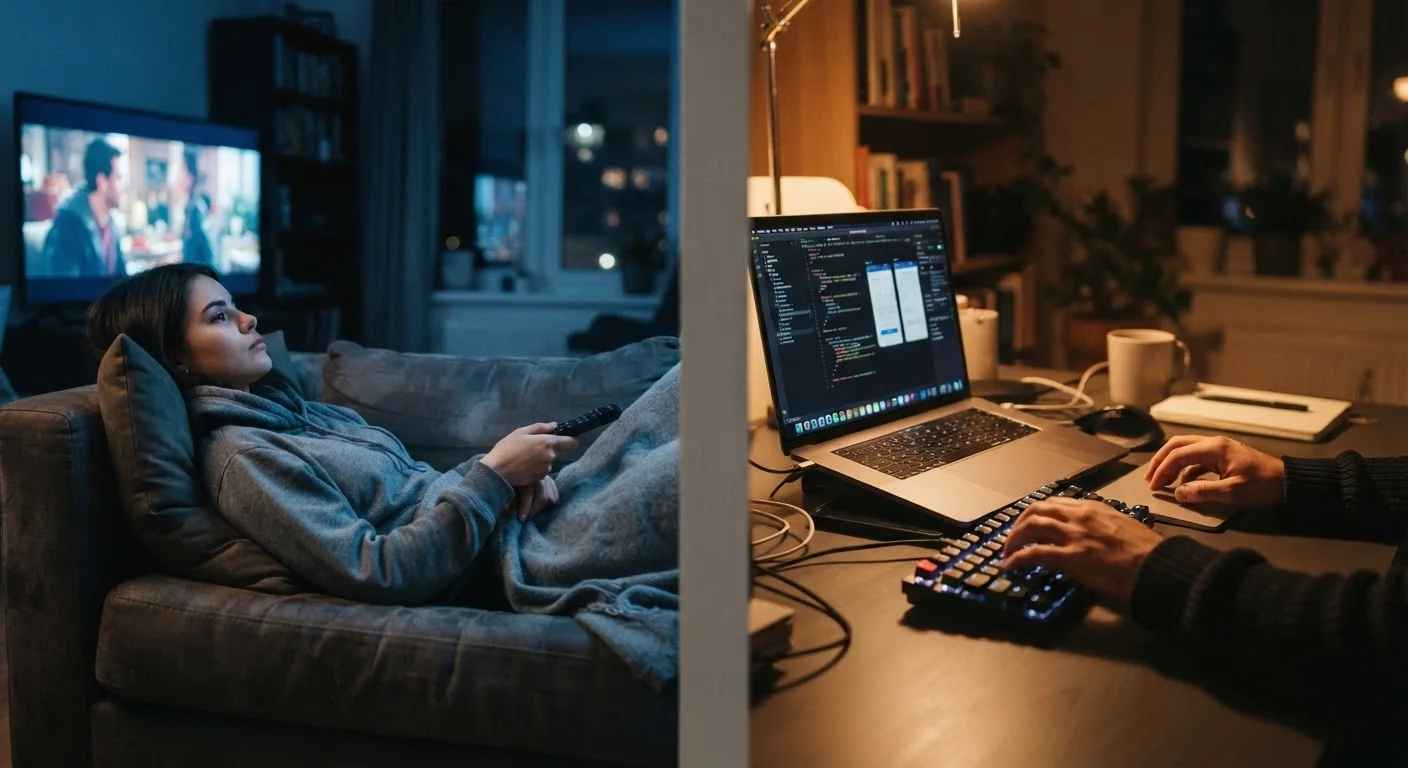
Defining the Two Modes
The distinction between passive and active screen use comes down to one key factor: cognitive engagement. Passive screen use means consuming digital content without meaningfully responding to or shaping it - think autoplay video queues, infinite social media scrolling, or background streaming. The screen delivers; you receive.
Active screen use, by contrast, requires you to do something with intention. Composing an email, editing a photo, participating in a video call, working through an online course, or writing a forum post all demand decision-making, attention, and some degree of creative or analytical effort. As discussed in what screen time actually measures and what it misses, raw hours logged on a device can't tell you which mode you're in - and that omission matters significantly.
It's also worth noting that the boundary isn't always rigid. Reading a long-form article attentively is more active than it first appears. Watching a video lecture while taking notes crosses firmly into active territory. Context and intent help place any given behavior on the spectrum.
What the Research Says About Wellbeing
A body of psychological research has examined whether all screen time carries the same wellbeing implications. The short answer is no - but the picture is nuanced.
Studies by Andrew Przybylski and colleagues at the Oxford Internet Institute have used large-scale datasets to test whether screen time links to lower adolescent wellbeing. Their findings generally show modest and context-dependent associations rather than sweeping harms. Crucially, the type of engagement consistently emerges as more meaningful than total time. Passive consumption - particularly prolonged, unstructured scrolling - shows stronger associations with lower mood and higher feelings of loneliness than active, communicative, or creative use.
~2 hrs
Daily social media use among U.S. adults
Pew Research Center surveys consistently place average U.S. adult social media use in the range of one to two-plus hours daily, much of it passive scrolling.
Modest
Effect size of screen time on teen wellbeing
Oxford Internet Institute research found screen time effects on adolescent wellbeing are statistically small - comparable to the effect of wearing glasses, per Przybylski and Weinstein (2017).
Type > Time
Key predictor of screen-related wellbeing outcomes
Multiple studies indicate that the nature of digital engagement - passive versus active - is a stronger predictor of wellbeing impact than total hours spent on devices.
Social comparison theory offers one plausible mechanism: when people scroll passively through curated content, they are more likely to compare themselves unfavorably to idealized images or lifestyles, without the balancing effect of actual social exchange. Active use - such as direct messaging or collaborative content creation - is less likely to trigger that dynamic because the user is a participant, not just an observer.
This connects to a broader pattern explored in the difference between lurking and participating online: passive observation and active contribution to digital communities produce meaningfully different social and psychological experiences.
How to Apply This Distinction in Practice
Understanding this framework has practical value - not as a reason for alarm, but as a tool for self-awareness. A few principles are worth keeping in mind:
- Intent before device: Ask what you're trying to accomplish before picking up your phone or opening a laptop. A clear purpose tends to push use toward the active end of the spectrum.
- Design matters: Many platforms are deliberately built to extend passive consumption through autoplay, infinite scroll, and algorithmically optimized feeds. Recognizing these design choices as prompts - not neutral features - helps you make more deliberate decisions about engagement.
- Balance across the day: Neither mode is inherently harmful in moderation. Passive viewing as part of rest is different from passive scrolling that displaces sleep, physical activity, or face-to-face interaction.
Screen Time Metrics Don't Capture This
Built-in screen time tools on smartphones and tablets track total minutes by app category, but they cannot distinguish between passive and active use within those categories. Ten minutes of actively writing a message and ten minutes of mindless scrolling register identically. This is a meaningful limitation when interpreting your own usage data.
For families thinking through these questions across age groups, how digital habits shift across the lifespan provides additional context on how passive and active patterns play out differently at various developmental stages.
The goal isn't to eliminate passive screen time - it's to be aware of when it's a deliberate choice versus a default drift. That awareness, more than any specific hour count, is what gives you meaningful information about your own digital habits.