
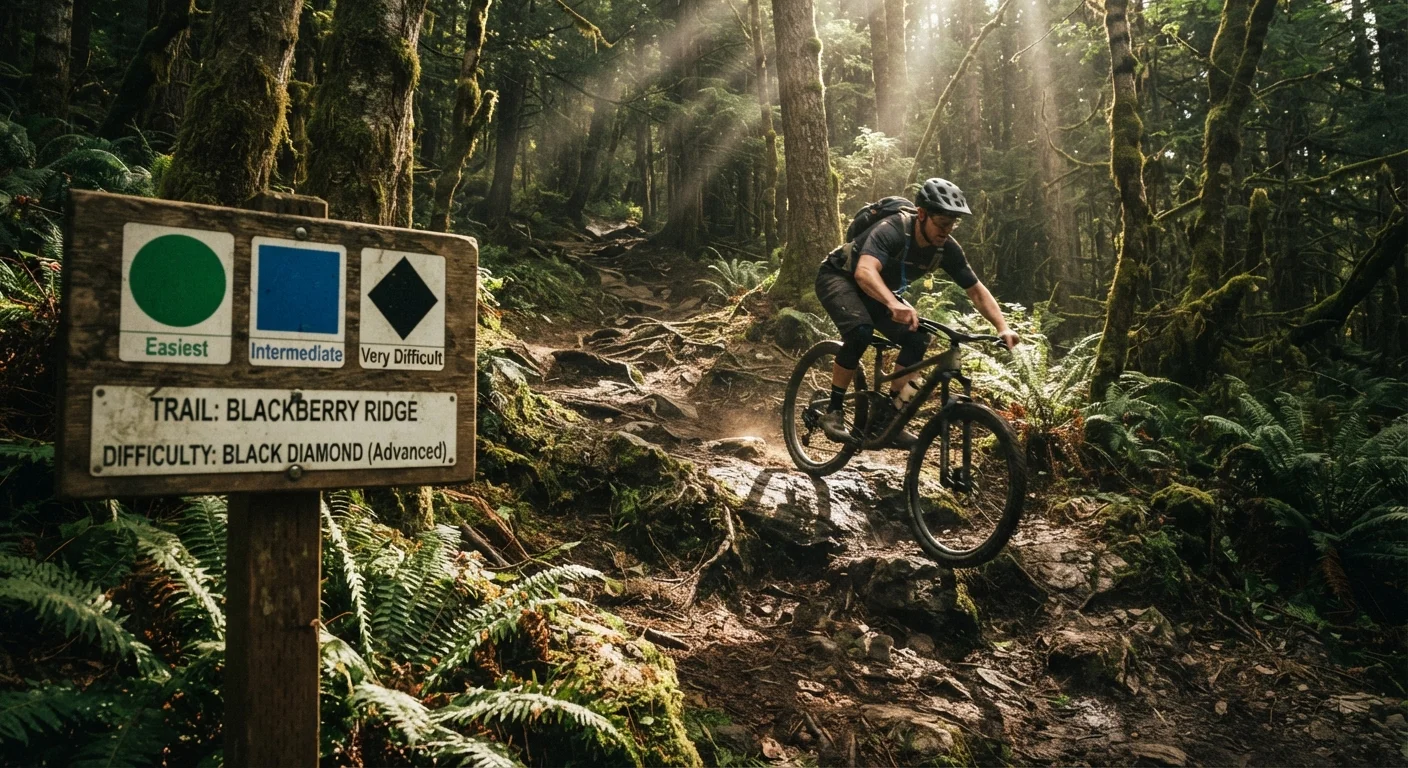
Why Trail Ratings Exist - and Why They're Not Universal
Walk up to the trailhead of almost any bike park or managed trail network in the United States and you'll see colored symbols - green circles, blue squares, black diamonds - borrowed loosely from ski resort culture. These markers are meant to tell you, at a glance, how technically demanding the trail ahead is. The problem is that unlike ski runs, mountain bike trails have no single governing body that enforces a standardized rating scale across every network in the country.
What that means in practice: a blue-square trail at a beginner-friendly state park may feel nothing like a blue-square trail at a major destination bike park. Local trail builders, resorts, and volunteer crews each apply their own interpretations. Understanding the common frameworks - and their limitations - helps you avoid being caught off guard on terrain that doesn't match your skill level.
| Rating System Origin | Adapted from alpine ski resort difficulty symbols |
| Governing Body | None universal; IMBA provides voluntary guidelines (International Mountain Bicycling Association) |
| Most Common Tiers | Green, Blue, Black Diamond, Double Black Diamond |
| Bike Park Difference | Feature-specific ratings may appear within a single trail |
| Key Caution | Same color rating can vary significantly between trail networks |
The Common Color-Code System Explained
Most North American trail networks use some variation of a four-tier color system. Here's what each level generally signals:
- Green (Easiest): Smooth, wide, relatively flat trails with minimal obstacles. Suitable for beginners and young riders still building bike-handling skills. Turns are gradual and surfaces are typically packed dirt or gravel.
- Blue (Intermediate): Moderate terrain with some rocks, roots, banked turns, or mild elevation change. Riders should be comfortable with basic braking, shifting, and maneuvering. Flow trails and cross-country singletrack often fall here.
- Black Diamond (Difficult): Significant technical challenge - steep grades, exposed roots, large rocks, narrow singletrack, drop-offs, or tight switchbacks. Requires confident bike control and experience reading terrain at speed.
- Double Black Diamond (Expert): Reserved for extreme terrain: near-vertical drops, mandatory air features, loose and unpredictable surfaces, or highly technical rock gardens. Mistakes on these trails carry real injury risk.
Some networks add a White or Introductory rating below green for very young children or absolute first-timers on flat, paved, or compacted loops.
Singletrack
A narrow trail wide enough for only one rider at a time, typically 18-24 inches across. Singletrack is the dominant trail type in mountain biking and ranges from beginner-friendly to expert-level.
Switchback
A sharp, zigzagging turn on a steep hillside that allows trails to climb or descend without going straight up. Switchbacks require precise low-speed bike control.
Berm
A banked, curved section of trail built to help riders maintain speed through a corner. Berms are common on flow trails and bike park routes.
Rock Garden
A trail section densely covered with rocks of varying sizes that riders must navigate. Rock gardens are a defining technical challenge on black and double-black trails.
Flow Trail
A purpose-built trail designed for smooth, rhythmic riding with machine-sculpted berms, rollers, and jumps. Flow trails typically land in the blue difficulty range.
IMBA
The International Mountain Bicycling Association, a nonprofit that advocates for trail access and publishes widely referenced trail design and difficulty guidelines.
IMBA and Bike Park Ratings: Two Overlapping Systems
The IMBA - a nonprofit trail advocacy organization - has published its own trail difficulty criteria that many land managers reference. IMBA's framework emphasizes measurable features: tread width, cross-slope, obstacle frequency, and overall exposure. When a trail network advertises IMBA-aligned ratings, it implies a more deliberate attempt at consistency.
Bike parks operated by ski resorts (where lifts carry riders uphill) often apply stricter internal standards because their terrain is purpose-built with defined jumps, drops, and berms. These parks typically mark features within a trail - for example, a blue trail might contain an optional black-rated jump line alongside a green-rated roll-around. Pay close attention to feature-specific signage, not just the trail's overall color.
Bike Park vs. Natural Trail Ratings
Ratings at commercial bike parks - where terrain is purpose-built and maintained by staff - tend to be more consistent and feature-specific than those on natural trail networks managed by volunteers or land agencies. If you're new to a style of terrain, starting at a bike park can give you a more calibrated sense of difficulty levels before venturing onto natural singletrack.
If you enjoy reading terrain before you ride it, the skill of interpreting elevation and contour data is genuinely useful. See our guide to reading topographic maps for a practical introduction to topo map skills that translate well to trail planning.
Matching Your Skills to the Right Trail
Ratings are a starting point, not a guarantee. Before committing to a trail, consider these practical checks:
- Read recent trail reports. Conditions change with weather - a blue trail after heavy rain can behave like a black. Many trail apps and local club sites post condition updates.
- Look at photos or videos. User-submitted footage on trail apps gives a much clearer picture of actual features than a color symbol alone.
- Start at the bottom of a network's difficulty range. If you're visiting a new park, ride an easier trail first to calibrate how that specific network rates difficulty before advancing.
- Understand that ratings describe terrain, not fitness. A long green trail at altitude can exhaust a rider who focuses only on technical difficulty markers.
The same awareness that helps trail runners adapt to off-road conditions applies to mountain biking. Our overview of trail running versus road running explores how leaving pavement changes everything - a mindset shift equally relevant to new mountain bikers.