Why Football Penalties Confuse Fans
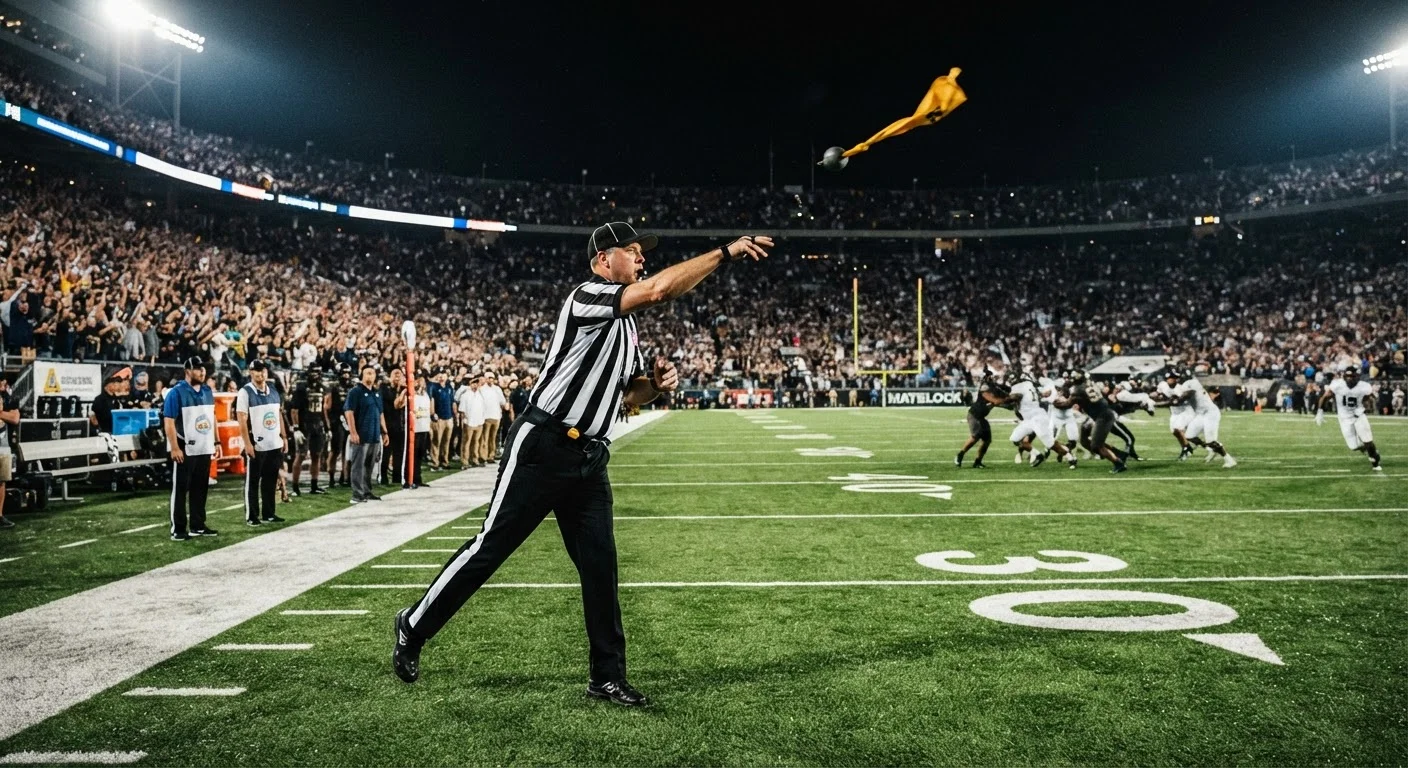
A yellow flag sails through the air. The referee clicks on a microphone and announces something about "illegal use of hands" or "offsetting penalties." Half the stadium groans; the other half cheers - and plenty of viewers at home have no idea what just happened.
American football has one of the most complex rule sets in professional sports. The NFL rulebook runs hundreds of pages, and college football adds its own variations on top of that. Understanding the most common penalties doesn't just make watching more enjoyable - it genuinely changes how you read the game.
For a broader vocabulary of sports terms, check out the Sports Fandom Glossary for more context on the language fans use.
| Penalty flag color | Yellow (Standard across NFL and NCAA football) |
| Most common penalty (NFL) | False start (Consistently among the top-called penalties each season) |
| Standard holding penalty | 10 yards (offense), 5 yards (defense) (NFL rulebook) |
| Personal foul yardage | 15 yards (NFL and NCAA) |
| Downs per possession | 4 (Both NFL and college football) |
The Most Common Penalty Flags Explained
Penalties fall into two broad categories: pre-snap (called before the ball is snapped) and post-snap (called after the play has started). Here are the ones you'll see most often.
False Start
A false start occurs when an offensive player moves illegally before the snap. Only one offensive player - the center - is allowed to move the ball. This is a 5-yard penalty and one of the most frequent calls in the game.
Holding
Holding is called when a player - usually a blocker - grabs an opponent's jersey or body to impede their movement illegally. Offensive holding results in a 10-yard penalty and a loss of down. Defensive holding is 5 yards and an automatic first down.
Pass Interference
When a defender makes illegal contact with a receiver who is attempting to catch a pass, that's pass interference. In the NFL, the ball is spotted at the point of the foul - potentially a massive gain for the offense. In college football, it's a 15-yard penalty regardless of distance.
Encroachment and Offsides
These are frequently confused. Encroachment happens when a defensive player crosses the line of scrimmage and makes contact with an offensive player before the snap. Offsides is when any player is in the neutral zone when the ball is snapped. Both are 5-yard penalties.
Personal Foul and Roughing the Passer
Personal fouls cover a range of dangerous or unsportsmanlike contact - late hits, helmet-to-helmet collisions, and unnecessary roughness. Roughing the passer specifically protects the quarterback after they've released the ball. Both carry 15-yard penalties and an automatic first down when called against the defense.
Line of scrimmage
An imaginary line across the field where the ball is placed before each play. Neither team may cross it legally until the ball is snapped.
Neutral zone
The space between the two lines of scrimmage - essentially the length of the football. No player except the center may occupy this space before the snap.
Spot foul
A penalty enforced at the location where the foul occurred rather than from the original line of scrimmage. Pass interference in the NFL is the most notable example.
Automatic first down
When certain defensive penalties are called, the offense is awarded a first down regardless of how many yards to go they had before the penalty.
Offsetting penalties
When both teams commit penalties on the same play, the fouls cancel each other out and the down is replayed from the original line of scrimmage.
Loss of down
A penalty consequence where the offense uses up one of their four downs as part of the punishment, in addition to any yardage penalty.
How Referee Signals Work
Referees communicate calls visually to players, coaches, and fans through a standardized set of hand signals. Learning a few key ones helps you follow the action even before the announcement.
- Arms extended overhead: Touchdown or successful field goal
- Hands on hips: Illegal motion or false start
- One arm swinging downward: Holding
- Arms crossed at the wrists: Pass interference or illegal contact
- Fists rotating in front of the chest: Delay of game or offsides
When officials announce "offsetting penalties," it means both teams committed fouls on the same play. The penalties cancel each other out, and the down is replayed. This is one of the most confusing outcomes for casual viewers but is straightforward once you understand the concept.
Unlike football's written rulebook, baseball operates on a parallel set of traditions - explore baseball's unwritten rules for a different look at how sports govern player conduct.
NFL vs. College Football: Key Rule Differences
The NFL and college football share the same basic framework but differ on several important rules that affect how penalties play out.
| Rule Area | NFL | College |
|---|---|---|
| Pass interference | Spot foul (can be huge) | 15-yard maximum |
| Catch requirements | Two feet in bounds | One foot in bounds |
| Targeting | 15-yard penalty | 15 yards + ejection |
| Clock after first down | Clock runs | Clock stops briefly |
The "targeting" rule - designed to discourage helmet-to-helmet contact - is enforced more strictly in college ball, where a player can be ejected for a first offense. Understanding these distinctions helps when switching between NFL Sundays and college football Saturdays.
If you're also trying to make sense of roster moves and player transactions, why sports trades feel confusing breaks down how front-office decisions work across leagues.