
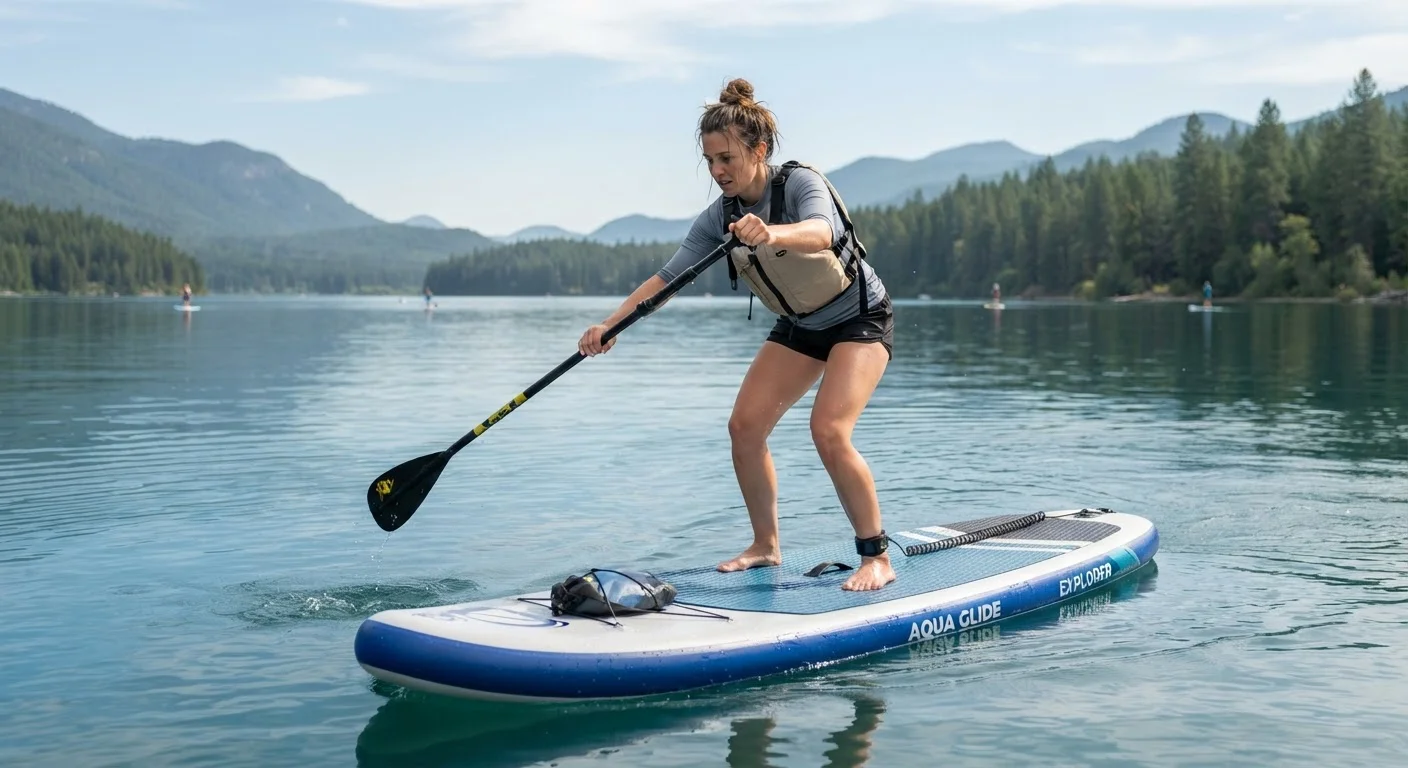
Why Balance Feels So Hard on a SUP Board
Stand-up paddleboarding (SUP) looks effortless when experienced riders do it. For beginners, the board feels like it has a mind of its own. That disconnect isn't a talent gap - it's almost always a set of correctable mechanical errors that most new paddlers make within the first few minutes on the water.
Unlike a kayak, where your center of gravity sits low and the hull provides inherent stability, a SUP board asks you to stand upright on a surface that responds to every micro-shift in your body. That responsiveness is what makes it fun once you understand it - and what makes it humbling before you do. If you're curious how paddleboarding compares to other entry-level paddle sports, see our guide to getting started with kayaking for a useful side-by-side perspective on water-based balance challenges.
The mistakes below are responsible for the vast majority of early wipeouts. Fixing even two or three of them in a single session can transform your experience on the water.
Standing with feet too narrow or misaligned on the board.
Why it happens: Beginners instinctively bring their feet together as if standing on solid ground, which dramatically narrows the stability base.
Locking the knees straight instead of maintaining a slight bend.
Why it happens: Straight legs feel stable on land, so new paddlers default to them. On water, locked knees transmit every ripple directly to your hips and upper body with no shock absorption.
Looking down at the board or at the water immediately below your feet.
Why it happens: Anxiety causes new paddlers to watch their feet, the same way new cyclists stare at the ground in front of their tire. This tilts the head forward and shifts body weight.
Gripping the paddle too tightly or holding it at the wrong angle.
Why it happens: Fear of dropping the paddle causes a white-knuckle grip, which tenses the arms and shoulders and transfers that rigidity into the body's core balance system.
Overcorrecting every wobble with large, panicked movements.
Why it happens: The instinct to catch yourself from falling is powerful. New paddlers make big, sudden weight shifts that actually amplify the instability rather than correct it.
The Adjustments That Matter Most
Understanding what you're doing wrong is only half the battle. The other half is knowing which corrections produce results fastest so you don't spend three sessions fighting the same problems.
~3M
Americans who participate in SUP annually
According to the Outdoor Industry Association, stand-up paddleboarding consistently ranks among the fastest-growing water recreation activities in the United States.
2-4
Sessions to noticeable balance improvement
Paddleboarding instructors commonly report that most beginners experience significant stability gains within their first two to four on-water sessions when basic technique errors are addressed early.
Start with your gaze, then your knees. These two adjustments cost nothing and deliver immediate feedback. Fixing your foot position is the next priority - once your stance is centered and shoulder-width apart, the board becomes noticeably more predictable. Grip and paddle mechanics come after that, since poor paddle technique creates instability through uneven stroke forces.
It also helps to give yourself the right conditions to learn. Flat, calm water without boat traffic or wind chop removes variables that even intermediate paddlers find challenging. Renting a wider, higher-volume board for your first few sessions rather than borrowing a narrower performance board is a practical choice that lets you focus on technique rather than survival. As your balance improves, you can progress to narrower shapes that reward more refined movement.
Always Wear a Personal Flotation Device
Regardless of your swimming ability or water conditions, wearing a Coast Guard-approved personal flotation device (PFD) is required by law in many states and strongly recommended everywhere. Falling is a normal and frequent part of learning to paddleboard. Attach your leash to your ankle so the board stays close when you do fall, and never paddle beyond a distance you can safely swim back from.
Patience with the learning curve matters. Most paddleboarders report a noticeable stability improvement between their second and fourth sessions - not because they got stronger, but because their nervous system learned to stop overcorrecting every small wobble. Trust the process, stay low when in doubt, and get back on the board after every fall.