How Each Technology Delivers Data
All four connection types move data between your home and the broader internet, but the physical medium and method are quite different. Understanding that difference helps explain why each technology has its own speed ceiling, latency profile, and geographic footprint.
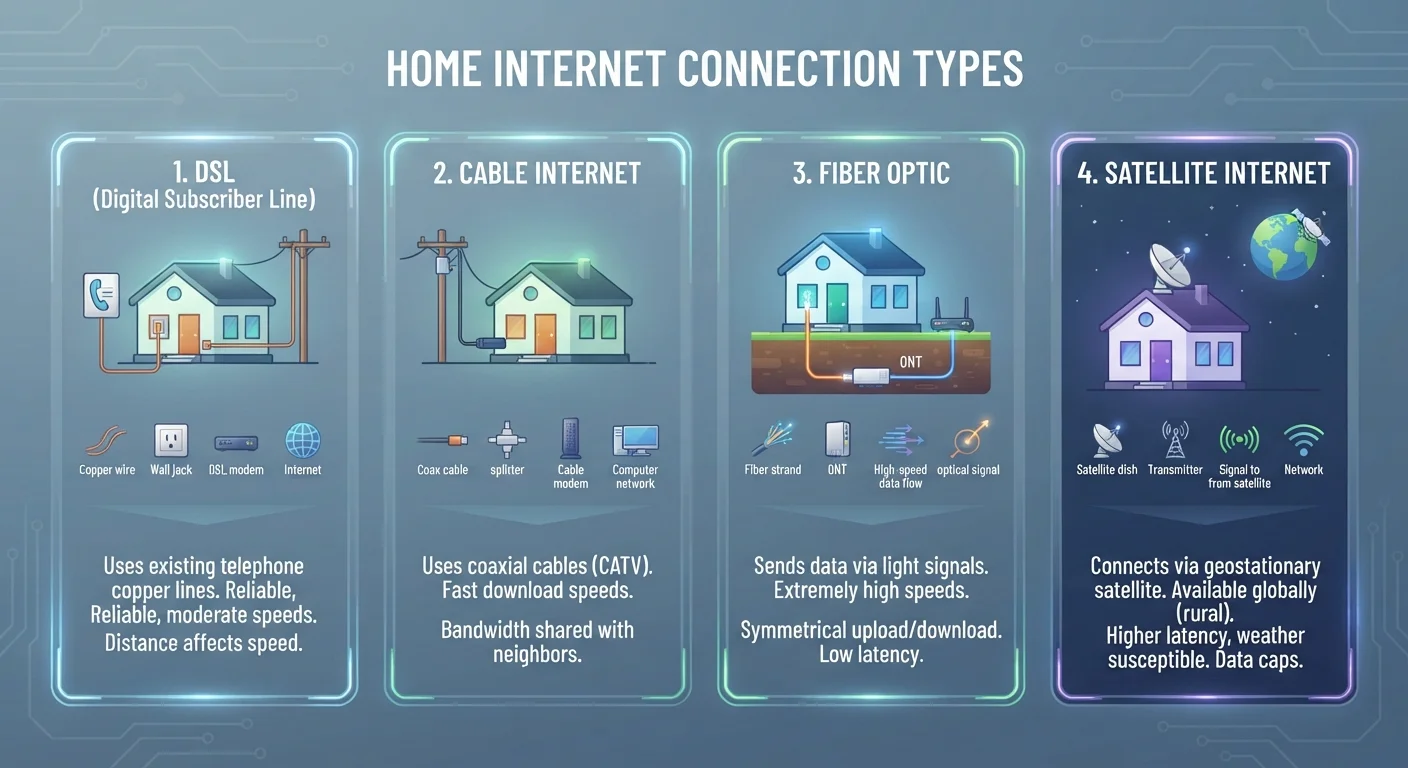
DSL (Digital Subscriber Line) transmits data over the copper telephone wires already installed in most homes. Because these wires were designed for voice calls, not high-bandwidth data, they impose real speed limits - and performance degrades the farther your home sits from the telephone company's local switching facility (called a central office or remote terminal).
Cable internet travels through coaxial cable - the same thick, shielded wire that carries cable TV signals. Coaxial cable can carry far more data than copper phone lines, which is why cable typically delivers higher speeds than DSL. One characteristic of cable infrastructure: neighbors in the same area often share a segment of the network, which can cause speeds to dip during peak usage hours.
Fiber optic internet uses thin strands of glass or plastic to transmit data as pulses of light. Light moves fast and doesn't degrade over long distances the way electrical signals do. This is why fiber can deliver symmetrical speeds - meaning upload speeds match download speeds - unlike DSL or cable, where downloads are almost always much faster than uploads.
Satellite internet bypasses ground-based infrastructure entirely. Your home has a dish that communicates with a satellite in orbit, which in turn connects to ground stations linked to the internet backbone. Traditional geostationary satellites orbit about 22,000 miles above Earth, producing noticeable signal delays (latency). Newer low-Earth orbit (LEO) satellite services orbit much closer - a few hundred miles up - significantly reducing that delay. See our plain-language overview of US internet access for broader context on how these networks fit into the national picture.
Speed, Latency, and Reliability Compared
Speed and latency are separate concepts that each affect your experience differently. Speed (measured in Mbps or Gbps) determines how quickly data transfers. Latency (measured in milliseconds, ms) is the delay between sending a request and receiving a response - critical for video calls, online gaming, and real-time applications.
| DSL | Cable | Fiber | Satellite | |
|---|---|---|---|---|
| Typical download speeds | 1-100 Mbps | 25-1,000 Mbps | 100 Mbps-5 Gbps | 25-220 Mbps |
| Upload speeds | Slow (asymmetric) | Moderate (asymmetric) | Fast (often symmetrical) | Low to moderate |
| Typical latency | 25-75 ms | 15-35 ms | 5-20 ms | 20-60 ms (LEO); 600+ ms (GEO) |
| Infrastructure used | Copper phone lines | Coaxial cable | Fiber optic strands | Orbital satellites |
| Geographic coverage | Very wide | Broad (urban/suburban) | Limited (expanding) | Near-universal |
| Weather sensitivity | Moderate | Low | Very low | High |
| Shared network segment | Sometimes | Yes | Generally no | No |
Reliability also varies by technology. Fiber signals don't degrade from electrical interference and aren't shared between neighbors, giving it a consistent edge. Cable is generally reliable but susceptible to neighborhood congestion. DSL performance can drop noticeably in wet weather and as distance from the provider's facility increases. Satellite is the most weather-sensitive of all - heavy rain or dense cloud cover can interrupt the signal. For a deeper look at what speed figures mean in practice, our guide to internet speed tiers explains the numbers behind advertised plans.
Availability and Geographic Coverage
Where you live matters more than any preference you might have. Fiber, despite its performance advantages, reaches a minority of US addresses - deployment is expensive and has historically concentrated in cities and newer residential developments. Cable coverage is substantially broader, encompassing most suburban and urban areas. DSL covers more of the country than either, because telephone lines were built into nearly every community over the past century. Satellite, by design, can serve virtually any address with a clear view of the sky, making it the default option for many rural and remote households.
Check Actual Availability at Your Address
Advertised coverage maps don't always reflect what a provider can actually deliver to your specific home. Before making any decision, contact local providers directly and ask neighbors about their real-world experience. The FCC's broadband map (broadbandmap.fcc.gov) is a useful starting point but should be treated as a first check, not a definitive answer.
The Federal Communications Commission (FCC) maintains broadband availability maps that let consumers check which technologies are reported as available at a specific address. Keep in mind that reported availability doesn't always match actual service - providers have historically overcounted coverage. The digital divide article explores why access gaps persist across rural, urban, and tribal communities.
Practical Trade-Offs to Consider
Each technology involves compromises beyond raw speed and coverage. DSL and cable plans frequently impose data caps - monthly limits on how much data you can transfer before speeds are reduced or overage charges apply. Satellite plans have historically carried some of the strictest data limits, though newer LEO services have expanded those thresholds. Fiber plans are more commonly offered with no data caps, though this varies by provider.
Upload speeds are worth examining if you video conference, upload large files, back up data to the cloud, or work from home. DSL and cable are asymmetric - downloads are much faster than uploads. Fiber's symmetrical speeds make it better suited for these tasks. Satellite latency, even on LEO systems, can still create friction in real-time applications compared to wired connections.
Installation and equipment considerations differ too. Fiber often requires new wiring to be run into a home. Satellite requires a dish with a clear outdoor sightline and may face restrictions in apartments or homes governed by HOA rules. Cable and DSL installations are usually simpler since the wiring infrastructure is already in place. For insight into what ISPs charge for equipment, data policies, and plan structures, see our article on how ISPs structure pricing and data policies. If you're considering changing providers, what to verify before switching internet service outlines the key steps to take.