
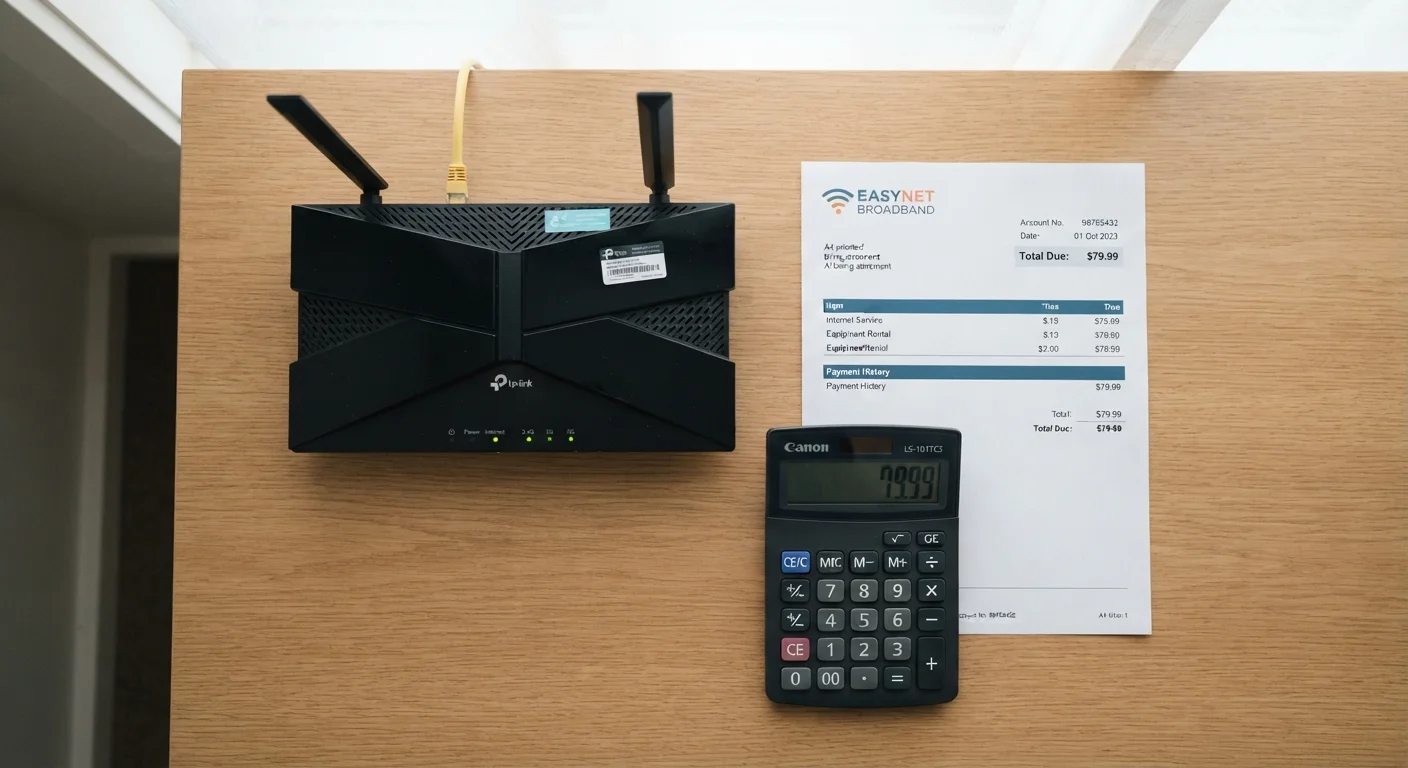
The Anatomy of an Internet Bill
When an ISP advertises a monthly rate - say, $49.99 - that figure rarely reflects what appears on the first invoice. Providers build plans from several components that together determine the true monthly cost.
The base service rate covers the speed tier and data allowance described in the plan. On top of that, most providers charge separately for the modem, router, or gateway device they supply. This equipment rental fee typically runs $10-$20 per month and appears as a line item. Subscribers who use their own compatible hardware can avoid this charge entirely.
Additional line items commonly include one-time installation or activation fees, regional taxes, and state or local franchise fees. Bundled service plans - those pairing internet with cable TV or home phone - may fold in a "broadcast TV fee" or "regional sports fee" that can add $10 or more. Together, these charges can push the real monthly cost 20-30% above the headline number.
For a broader picture of how American consumers access the internet and what shapes provider options in different regions, see our plain-language overview of US internet access.
~$76/mo
Average US home internet monthly bill
According to analysis published by the Pew Research Center and corroborated by Consumer Reports surveys examining broadband affordability.
1.25 TB
Common residential data cap from major cable ISPs
Several of the largest US cable providers set monthly data thresholds at 1 to 1.25 terabytes before overage fees or throttling apply.
$10-$20
Typical monthly equipment rental fee
ISPs commonly charge this fee for leasing a modem or gateway device; purchasing compatible equipment eliminates this recurring cost.
Introductory Pricing: What Changes After the Promotional Period
A large share of residential internet plans are sold at promotional rates that are explicitly time-limited. These introductory prices are designed to lower the barrier to switching providers and are valid for a defined term - typically 12 or 24 months - after which the account automatically moves to the standard rate.
The rate increase at the end of a promotional period can be substantial. Providers are required to disclose the promotional term and the post-promotion price, but this information is often buried in fine print. Reviewing the service agreement carefully before signing reveals these terms. Our guide on reading an ISP service agreement covers the specific clauses worth locating.
Some plans also include an early termination fee (ETF) if a subscriber cancels before the contract period ends. ETFs can range from $10 per remaining month to a flat fee of $150 or more, making mid-contract switching costly. Month-to-month plans avoid ETFs but often carry higher base rates.
Check the Promotion End Date Before Signing
When reviewing any internet plan, locate the exact date the introductory rate expires and note the standard rate that takes effect afterward. Set a calendar reminder a month before that date so you have time to call and negotiate, switch providers, or adjust your budget before the higher rate appears on your bill.
Data Caps, Throttling, and the Real Cost of Going Over
A data cap - also called a data allowance or data threshold - sets an upper limit on the total amount of data a household can transfer in a billing cycle. Once that threshold is crossed, ISPs typically respond in one of two ways: charging an overage fee for additional data consumed, or reducing connection speeds for the remainder of the month, a practice called throttling.
Common residential data caps from major cable providers sit around 1-1.25 terabytes (TB) per month. That volume accommodates most households, but heavy streaming, video conferencing, cloud backups, and gaming downloads can erode it quickly. Households that consistently approach the cap may find an unlimited data add-on or a higher-tier plan more cost-effective than repeated overage charges.
It is worth noting that fiber-to-the-home services are more likely to offer unlimited data at all tiers, while cable and DSL plans are more likely to impose caps. The technology itself plays a role in how providers structure these policies - a distinction explained in our article on DSL, cable, fiber, and satellite differences.
Speed Tiers and What They Mean for Pricing
ISPs typically segment service into speed tiers - grouped ranges of download and upload speeds that correspond to different price points. Entry-level tiers (25-100 Mbps download) are priced lower and marketed toward lighter users. Mid-tier plans (200-500 Mbps) target average households, while gigabit plans (1,000 Mbps) carry premium prices and are increasingly available in fiber-served areas.
The price gap between tiers is not always proportional to the speed increase. Moving from a 100 Mbps plan to a 300 Mbps plan might add $15 per month, while a jump to gigabit speeds might add $30-$50 more - depending on provider and market. Households often pay for more speed than they actually need. Understanding what different speed numbers mean in practice helps calibrate this choice: our explainer on internet speed tiers breaks down real-world implications for different household sizes and usage patterns.
A subscriber signs up for a cable internet plan advertised at $49.99 per month. After adding a $15 equipment rental fee, a $3 regional franchise tax, and a $2 broadcast surcharge, the first bill comes to $69.99.
A family of four streams 4K video on two TVs, plays online games, and works from home. By the 20th of the month, they have consumed 1.1 TB of their 1.25 TB data allowance.
A new subscriber locks in a $39.99 introductory rate for 12 months. When the promotion expires, the account automatically resets to the standard rate of $64.99 - an increase of $25 per month.
Reading Pricing Disclosures: What the New Labels Show
The FCC's Broadband Consumer Labels initiative introduced standardized disclosure requirements for ISPs. Modeled on nutrition labels, these disclosures must appear at the point of sale and list the monthly price, introductory rate expiration date, speed (typical download and upload), data cap, and all additional fees. The goal is to allow consumers to compare plans from different providers on equivalent terms.
When reviewing a Broadband Label, several fields warrant close attention: the introductory rate versus the monthly price after promotion, the one-time fees row (covering installation and activation), and the monthly fees section (covering equipment rental). The label does not cover every contractual detail - for clauses relating to service interruptions, speed guarantees, and dispute resolution, the full service agreement remains the authoritative document.
Pricing also interacts with network conditions in ways a label cannot fully capture. During peak evening hours, shared infrastructure can affect the speeds a subscriber actually experiences, regardless of plan tier. Our article on why internet slows during peak hours explains how network congestion factors into everyday performance.