Bandwidth, Speed, and Throughput: What Each Term Actually Means
These three terms appear constantly in internet plan descriptions, router specs, and tech support conversations - often as if they were interchangeable. They aren't.
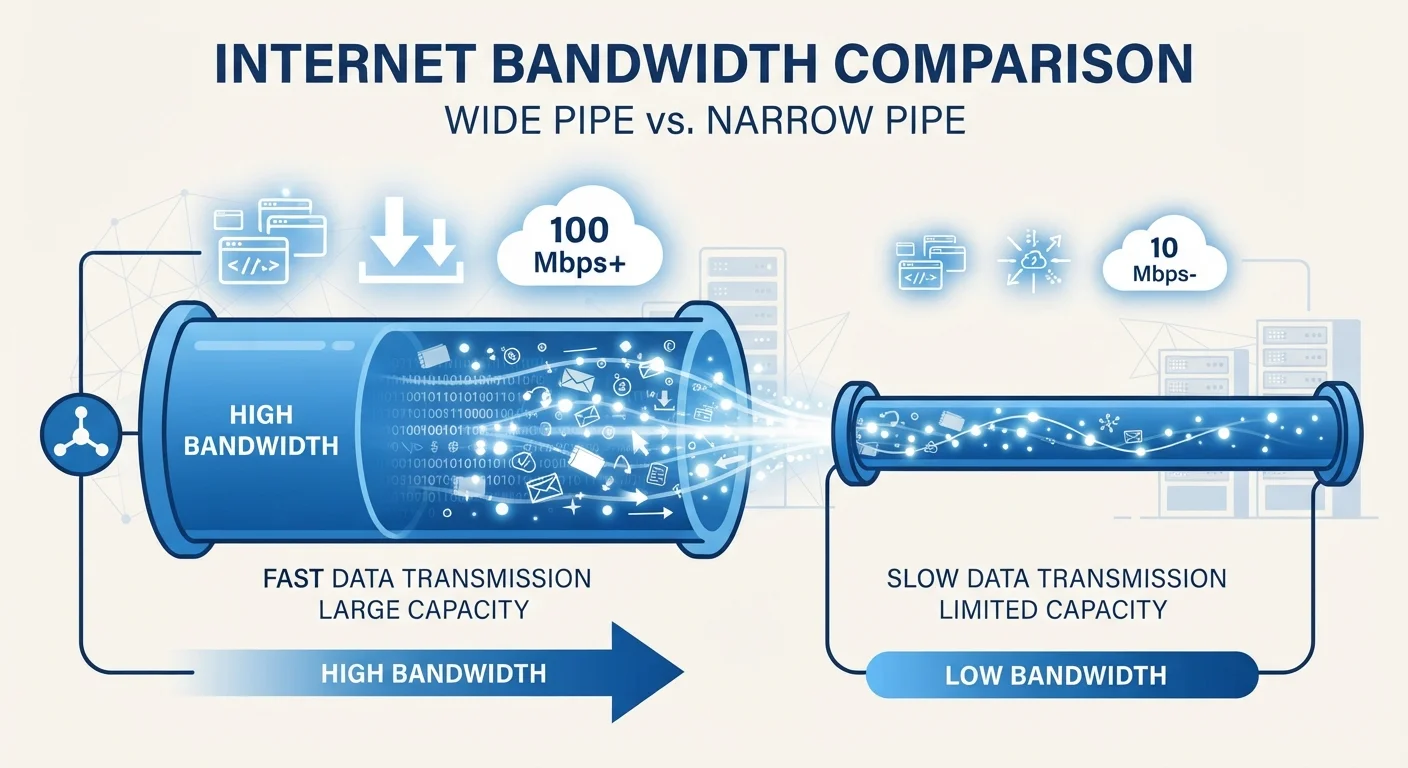
Bandwidth is the theoretical maximum data capacity of your connection - how much data could flow per second under perfect conditions. Speed is a looser term people use to describe how fast their connection feels, which is influenced by bandwidth but also by latency, server load, and local network conditions. Throughput is the most precise of the three: it's the actual measured data delivery rate between two points on a network at a specific moment.
A useful analogy: bandwidth is a pipe's diameter, throughput is how much water is actually flowing through it right now, and speed is how quickly that water reaches you. A wide pipe doesn't guarantee a strong flow if something is partially blocking it.
100 Mbps / 20 Mbps
FCC broadband definition threshold
The FCC updated its broadband benchmark in 2024 to 100 Mbps download and 20 Mbps upload, reflecting modern household usage patterns.
~25 Mbps
Bandwidth needed for one 4K stream
Netflix recommends approximately 25 Mbps for a single Ultra HD (4K) stream, illustrating how quickly high-quality video consumes available bandwidth.
~13
Average connected devices per U.S. home
According to Deloitte's Digital Media Trends research, U.S. households have connected an increasing number of devices, all competing for shared bandwidth.
For a deeper look at how connection type affects these numbers, see how DSL, cable, fiber, and satellite connections each deliver data.
Why Bandwidth Gets Shared - and What That Means for You
One of the most consequential things to understand about bandwidth is that it's shared across every device on your home network simultaneously. If your plan provides 200 Mbps and five devices are all active at once - streaming video, running a video call, downloading updates - that capacity is divided among them.
This is why a plan that feels fast with one device can feel sluggish during a busy evening at home. The total demand from all connected devices is measured against the single bandwidth ceiling your ISP provides to your address.
Shared infrastructure outside your home compounds this further. Many connection types, particularly cable, use neighborhood-level networks where dozens of households draw from a common pool. During peak hours, that shared pool shrinks per user. Why your internet slows down during peak hours explains the infrastructure reasons behind this pattern in more detail.
Check Both Upload and Download Figures
When reviewing any internet plan, always ask for the upload speed in addition to the advertised download figure. For households with remote workers, video callers, or anyone backing up data to the cloud, upload bandwidth can be just as important as download capacity. Plans vary widely in how generous their upload allocation is.
Upstream vs. Downstream: The Direction of Data Matters
Bandwidth isn't a single number - it has two directions. Download bandwidth governs how quickly data travels from the internet to your device: loading web pages, streaming video, receiving email attachments. Upload bandwidth controls the reverse: sending files, joining a video call, backing up photos to the cloud.
Most residential internet plans are asymmetric, meaning download bandwidth far exceeds upload. A plan advertised as "200 Mbps" typically means 200 Mbps download with a much smaller upload figure - sometimes as low as 10-20 Mbps. For most households historically focused on consuming content, this asymmetry worked fine.
That balance has shifted. Remote work, video conferencing, cloud backups, and content creation all demand meaningful upload capacity. Understanding both numbers - not just the download figure - is now essential when evaluating any plan. For a practical breakdown of what advertised numbers actually deliver, see what speed tier numbers mean in practice.
It's also worth noting that bandwidth is distinct from latency. Latency - measured in milliseconds - describes the delay in a round-trip data transfer. A connection can have high bandwidth but high latency, which causes problems for real-time applications like video calls and online gaming even when download speeds look strong on paper. Common myths about internet speed covers how these factors interact in ways that often surprise users.