More Creative Disciplines Than Most People Realize
When most people picture a creative hobby, painting or pottery usually comes to mind first. But the creative arts encompass dozens of disciplines, each with its own materials, history, and community of practitioners. Whether you're exploring for the first time or looking to branch out from a current practice, having a clearer map of the territory helps.
The forms listed below are among the most widely practiced in the United States. They range from visual and tactile mediums to literary and performance-based arts - and many blur those boundaries entirely. For a deeper look at how these categories are organized, see the full spectrum of creative hobbies.
Drawing
Drawing is one of the most fundamental forms of visual art and a common starting point for beginners. Using pencils, charcoal, ink, or pastels, practitioners render shapes, figures, and scenes on paper or other surfaces. It requires minimal equipment and can be practiced almost anywhere. Drawing underpins many other visual disciplines - understanding line, proportion, and shading carries over into painting, illustration, and printmaking. Styles range from realistic observational sketching to loose gesture drawing and abstract mark-making.
Drawing underpins nearly every other visual discipline, making it one of the most transferable skills in the creative arts.
Painting
Painting involves applying pigment - typically through watercolor, acrylic, oil, or gouache - to a surface such as canvas, paper, or wood panel. Each paint type has distinct handling characteristics: oil paints dry slowly and allow extensive blending, while acrylics dry quickly and can be applied in layers. Watercolor rewards transparency and spontaneity. Painters work in styles that span photorealism to pure abstraction, and the discipline has a centuries-long tradition in both fine art and decorative traditions.
Each type of paint handles differently, and choosing the right medium is often the first meaningful decision a new painter makes.
Fiber Arts
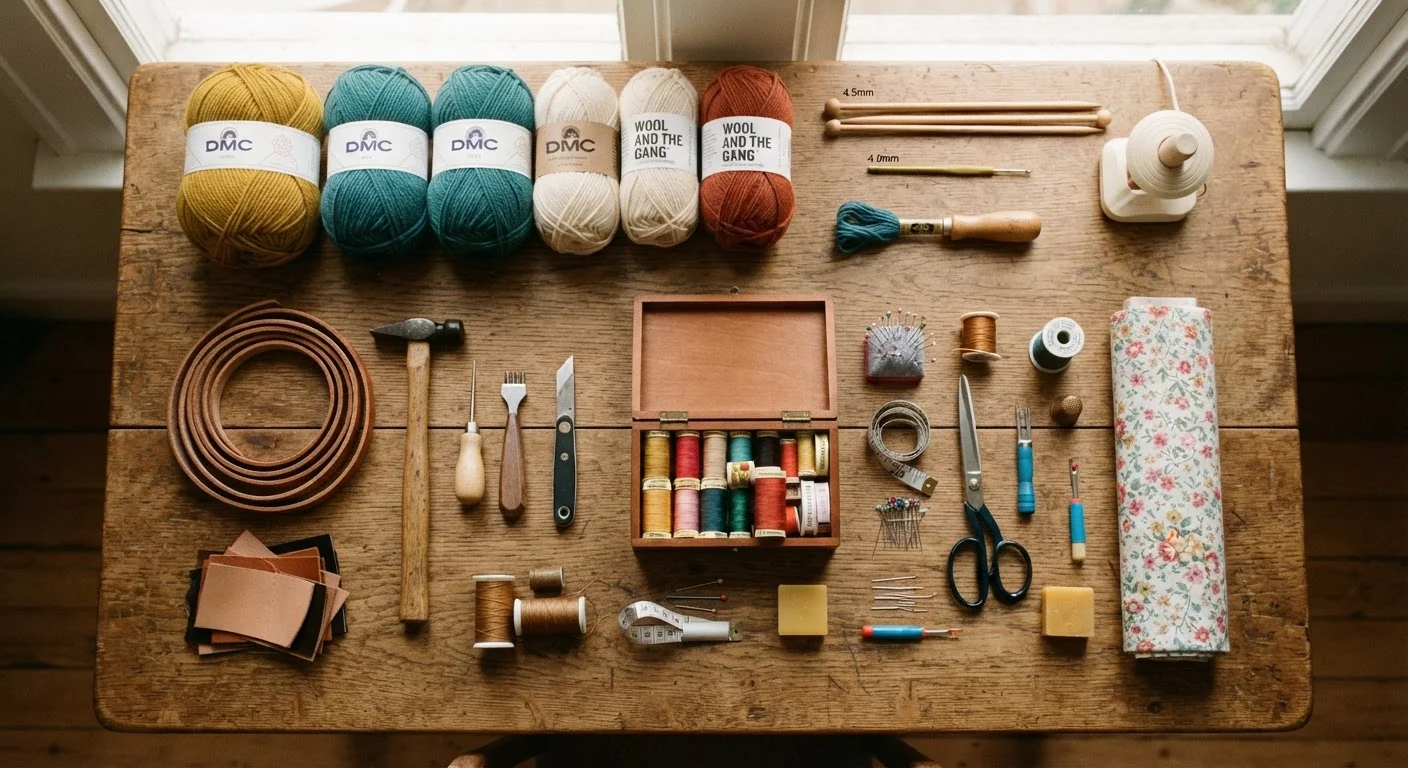
Fiber arts encompass knitting, crochet, weaving, embroidery, quilting, and related textile practices. Practitioners work with yarn, thread, fabric, and natural fibers to produce both functional objects - garments, blankets, bags - and purely decorative pieces. The field has a strong community culture in the United States, with local guilds, online forums, and pattern-sharing networks. Fiber arts are often praised for their meditative rhythm and the tactile satisfaction of working with physical materials. The line between fine art and craft becomes particularly relevant here, as textile traditions occupy both categories.
Fiber arts include a wide family of textile practices, each with its own tools, traditions, and thriving maker communities.
Ceramics and Pottery
Ceramics involves shaping clay by hand or on a wheel, then firing the finished piece at high temperatures to harden it. Pottery specifically refers to functional vessel forms - bowls, mugs, vases - though the broader ceramics field includes sculptural work as well. Glazing adds color and texture and requires its own technical knowledge. Many community centers and art schools offer access to kilns, which makes ceramics more accessible than the equipment cost might suggest. The process demands patience and a willingness to learn from pieces that don't survive the kiln.
Community kilns and studio spaces make ceramics far more accessible than the equipment requirements might suggest.
Creative Writing
Creative writing spans fiction, poetry, memoir, personal essay, screenwriting, and hybrid forms. Unlike many visual arts, it requires no physical materials beyond something to write with - making it one of the most accessible entry points into creative practice. Writers work across genres and length, from flash fiction under 1,000 words to book-length projects. Writing groups, workshops, and online communities provide feedback and accountability for those who want to develop their craft. The discipline rewards close attention to language, structure, and the way narrative can shape a reader's understanding of experience.
Creative writing demands no materials beyond time and attention, making it one of the most accessible creative disciplines.
Photography
Photography captures light through a lens to create still images - a process that can be pursued with everything from a smartphone to a professional camera system. Key concepts include composition, exposure, and lighting, all of which shape how an image reads to a viewer. Post-processing software has expanded the discipline further, allowing photographers to develop a distinct visual style in editing. Photography overlaps with documentary, portraiture, landscape, street, and abstract traditions, each with its own conventions and communities of practice.
Photography's core skills - composition, light, and timing - apply regardless of the equipment a photographer uses.
Music Making
Music making includes learning an instrument, vocal performance, songwriting, music production, and electronic composition. It encompasses both solo practice and collaborative ensemble work. Beginners often start with a single instrument and build theory knowledge gradually; others begin with digital audio workstations (DAWs) and explore production before picking up a traditional instrument. Music is one of the few creative disciplines where technical skill and expressive interpretation must develop together, and the path typically requires sustained, regular practice over months and years.
Music making uniquely demands that technical skill and emotional expression develop in parallel - you can't separate one from the other.
Printmaking
Printmaking is the process of creating images by transferring ink from a prepared surface - a plate, block, or screen - onto paper or fabric. Major techniques include relief printing (woodcut, linocut), intaglio (etching, engraving), screen printing, and monoprinting. Each method produces a distinct visual character and allows for reproducible editions of a single image. Printmaking bridges fine art and commercial design traditions, and many practitioners are drawn to it for the element of controlled unpredictability in the printing process itself.
Printmaking's appeal lies partly in its controlled unpredictability - the press often surprises even experienced practitioners.
Finding the Form That Fits You
No single creative discipline is universally right or wrong for any given person. The best fit depends on how you prefer to work - alone or with others, in silence or with sound, through structured technique or free experimentation. Many practitioners start in one area and naturally migrate toward adjacent ones over time.
Try Before You Commit
Many libraries, community centers, and makerspaces offer short workshops or open studio sessions in disciplines like ceramics, printmaking, or fiber arts. Sampling a medium for a few hours before investing in materials or classes is a low-risk way to test whether a discipline genuinely engages you. Community classes also connect you with practitioners who can offer guidance that's hard to find in books alone.
If you're new to any of these, this practical primer for beginners walks through how to choose a medium and set realistic expectations. And if you encounter unfamiliar terminology along the way, a glossary of creative arts terms covers the vocabulary you're likely to run into.