Why Backcountry Water Treatment Matters
Even the clearest alpine stream can harbor microorganisms capable of causing serious illness. Waterborne threats fall into three categories: protozoa (such as Giardia lamblia and Cryptosporidium), bacteria (like E. coli and Salmonella), and viruses (including norovirus and hepatitis A). Not every water source carries all three, but you rarely know for certain what's present without testing.
Your choice of treatment method should reflect where you're traveling, the likely contamination profile of the water source, and the practical realities of your kit. Whether you're on a weekend outing or a longer expedition - topics explored in our guide to different camping styles - matching your purification approach to your trip type is a skill worth developing.
Portable Filters: Workhorse of Domestic Backpacking
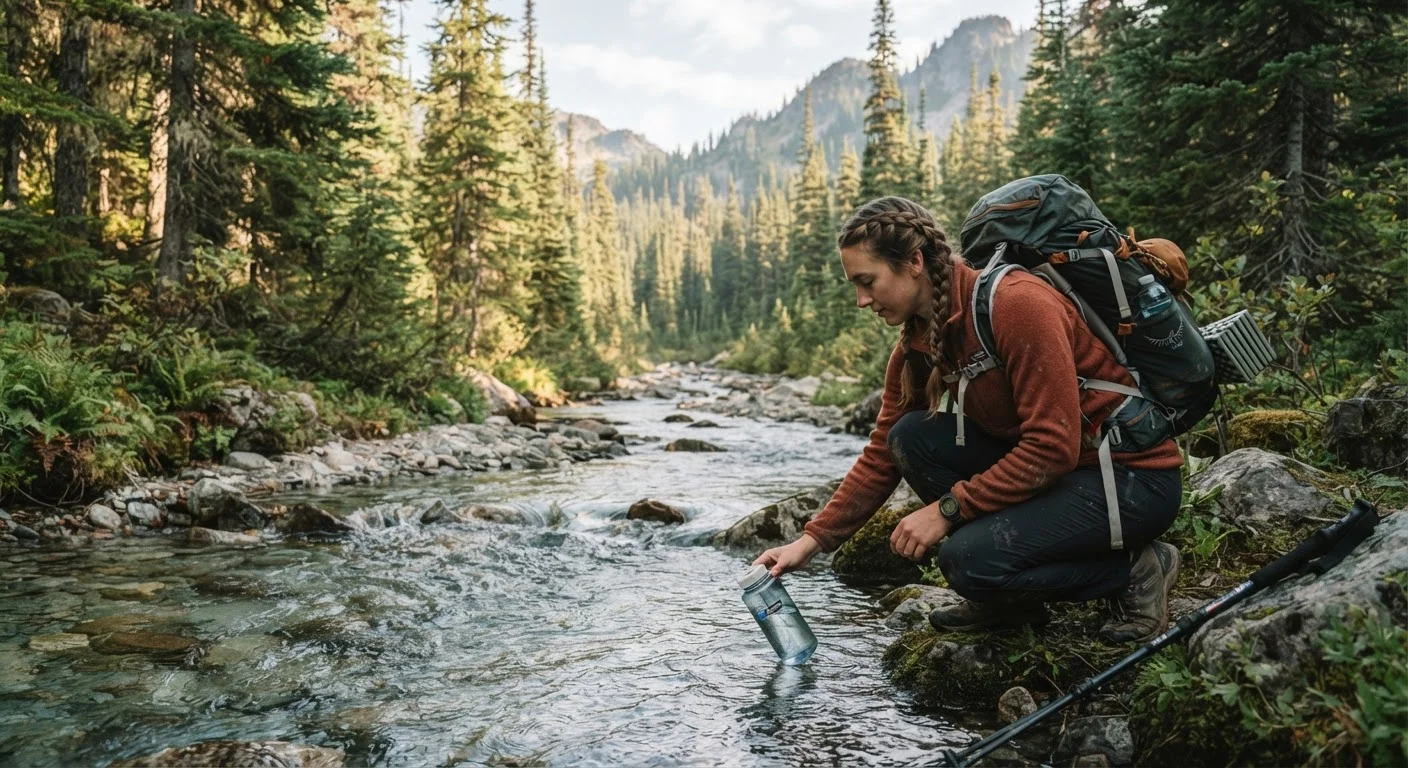
Pump, squeeze, gravity, and straw-style filters physically strain water through a hollow-fiber or ceramic membrane, typically removing protozoa and bacteria down to 0.1-0.2 microns. They're intuitive, require no wait time, and don't alter taste.
Key limitations: Standard filters do not remove viruses, which are far smaller than bacterial cells. In North America and most developed wilderness areas, viral contamination is considered low risk, making filters a practical choice. In regions with higher human activity near water sources - or internationally - a filter alone may be insufficient.
Filters also clog over time, particularly in silty or glacial water. Backflushing regularly extends their life. Cold temperatures can damage hollow-fiber membranes if the filter freezes while wet - a genuine concern on shoulder-season trips.
| Filter | Chemical (Chlorine Dioxide) | UV Device | Boiling | |
|---|---|---|---|---|
| Removes protozoa | Yes | Yes | Yes | Yes |
| Removes bacteria | Yes | Yes | Yes | Yes |
| Removes viruses | No (standard) | Yes | Yes | Yes |
| Wait time required | None | 30 min-4 hrs | 60-90 seconds | 5-10 min + cooling |
| Works in turbid water | Yes (may clog) | Yes (slower) | No (pre-filter needed) | Yes |
| Weight impact | Moderate | Very low | Moderate | High (fuel) |
| Affects taste | No | Yes (mild-strong) | No | No |
Chemical Treatment: Ultralight and Reliable
Iodine tablets, sodium hypochlorite (liquid bleach), and chlorine dioxide tablets or drops all work by chemically disrupting microbial cell function. Chlorine dioxide is the most capable option, effective against protozoa (including Cryptosporidium, which iodine does not reliably kill), bacteria, and viruses.
The tradeoffs are time and taste. Chlorine dioxide requires 30 minutes of contact time in clear water - up to four hours in cold or turbid conditions. Iodine leaves a medicinal flavor many find unpleasant and is not recommended for extended use or for people with thyroid conditions. A neutralizing tablet can reduce taste impact, but adds another step.
Pre-Filter Turbid Water First
If your water source is visibly cloudy or silty, strain it through a bandana or coffee filter before applying chemical or UV treatment. Sediment particles can shield microorganisms from both chlorine dioxide and UV light, reducing effectiveness. A two-step approach - mechanical pre-filter, then treatment - gives you more reliable results in challenging conditions.
For solo travelers - a scenario with its own set of considerations, as outlined in our piece on solo camping - chemical drops add almost no weight and serve as a dependable backup to any primary system.
UV Purifiers: Speed Against Viruses
Ultraviolet light devices work by disrupting the DNA of microorganisms, rendering them unable to reproduce. When used correctly in clear water, they're effective against protozoa, bacteria, and viruses in roughly 60-90 seconds. That speed, combined with broad-spectrum coverage, makes UV devices popular for international travel.
Critical constraints: UV light cannot penetrate turbid water effectively. If your source is silty or murky, you must pre-filter or let sediment settle before treating. UV devices also rely on batteries - a depleted charge in a remote location leaves you without your primary treatment method. Carrying a chemical backup is strongly advisable.
Boiling: Simple, Universal, Fuel-Intensive
Bringing water to a rolling boil - at any elevation, for at least one minute (three minutes above 6,500 feet) - kills all biological contaminants: protozoa, bacteria, and viruses. It requires no specialized equipment beyond a stove and pot, and there's no ambiguity about effectiveness.
The practical downsides are significant for most backcountry use. Boiling consumes fuel, produces hot water that must cool before drinking, and is cumbersome to repeat every time you need to fill a bottle. It remains the best option in true emergencies and for base-camp situations where a stove is already running. It does nothing to address chemical contamination.
A layered approach - combining a filter for sediment and pathogens with chemical treatment or UV as a virus backstop - offers comprehensive protection without over-relying on any single method. Understanding each tool's role lets you build a system suited to your specific conditions rather than defaulting to the heaviest or most expensive option.
~4 microns
Typical Giardia cyst size
Standard hollow-fiber filters with a 0.1-micron pore size reliably capture Giardia and Cryptosporidium cysts.
30-200 nm
Typical virus particle size
Viruses fall far below the filtration threshold of most portable filters, explaining why chemical or UV treatment is needed in high-risk areas.