How Each Network Is Built and Delivered
Fixed broadband and mobile data are fundamentally different technologies, not just different price tiers of the same thing. Understanding how each network is built explains why they behave the way they do.
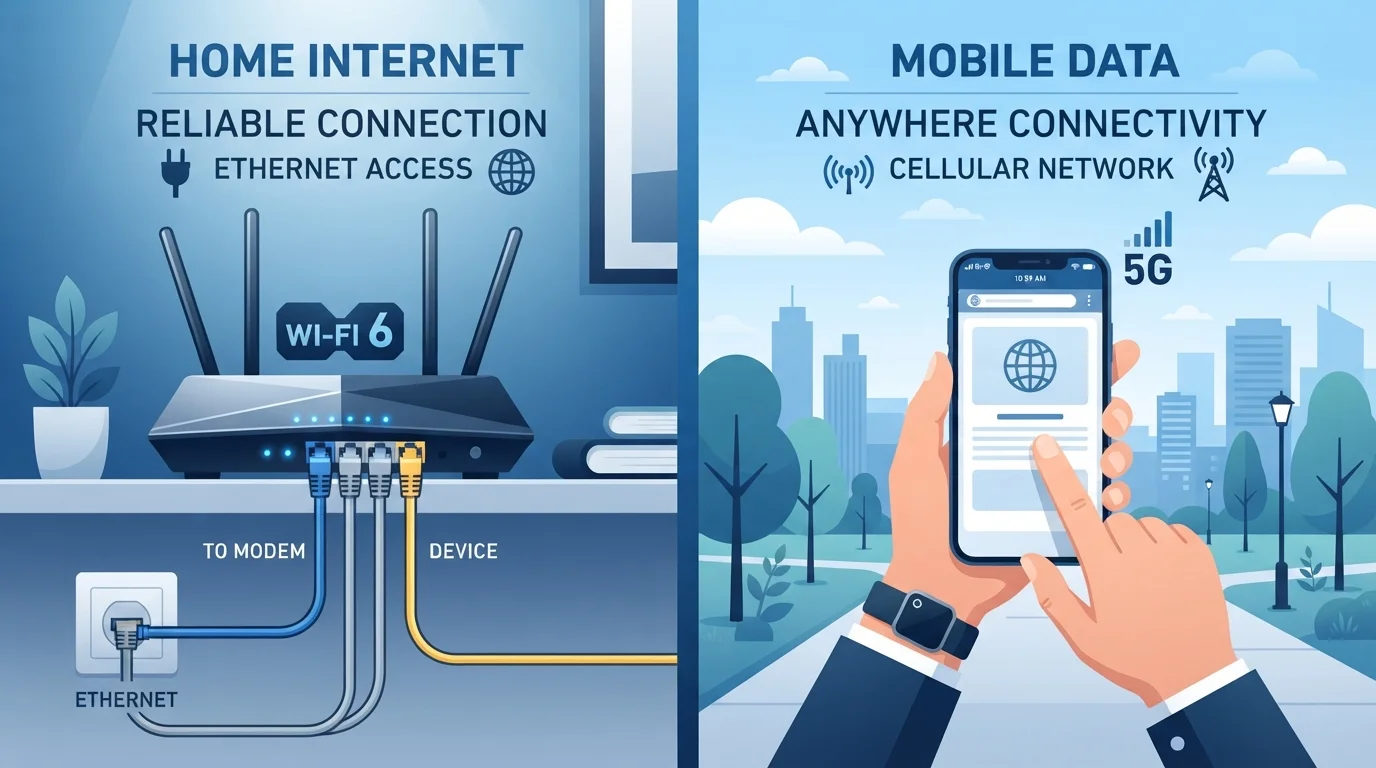
Fixed broadband delivers internet through physical lines - fiber-optic cables, coaxial cables, or copper phone lines - running from a provider's network to your home. A modem at your address converts those signals into usable internet, which a router then distributes via Wi-Fi or Ethernet. Because the connection is physical and dedicated to your location, it tends to be stable and high-capacity. For a deeper look at how each wired technology differs, see DSL, Cable, Fiber, and Satellite: What Actually Differs Between Them.
Mobile data works on an entirely different principle. Your device communicates wirelessly with nearby cellular towers using radio frequency signals. Those towers connect to the broader internet through their own backbone infrastructure. Because no physical line runs to your device, you can move freely - but you're sharing tower capacity with every other device in your area. Network generations (3G, 4G LTE, 5G) reflect improvements in how efficiently that radio spectrum is used.
| Criterion | Fixed Broadband | Mobile Data |
|---|---|---|
| Delivery method | Physical cable or fiber line | Wireless radio signals via cell towers |
| Portability | Fixed to a single address | Works wherever cellular coverage exists |
| Typical speeds | 100 Mbps-1 Gbps (fiber/cable) | 10-100+ Mbps (varies by generation) |
| Latency | Low and consistent (especially fiber) | Higher; subject to congestion |
| Data caps | Often unlimited or high-threshold | Frequent hard caps with throttling |
| Reliability | High; not affected by tower congestion | Variable; depends on signal and tower load |
| Installation required | Yes - technician or self-install kit | No - SIM card or device-ready |
| Rural availability | Often limited or unavailable | Broader reach where towers exist |
Performance, Reliability, and Data Limits
The structural differences above translate directly into real-world performance gaps most users will notice.
Fixed broadband connections - particularly fiber - routinely deliver symmetrical speeds of 100 Mbps to 1 Gbps or beyond, with low and consistent latency. Because a physical line isn't shared with neighbors in the same way a cellular tower is, performance tends to remain stable during peak hours. Common Myths About Internet Speed explains why raw speed numbers don't tell the whole story of your actual browsing experience.
Mobile data speeds vary considerably based on your location, signal strength, network congestion, and generation. 4G LTE averages are typically in the 10-50 Mbps range under ordinary conditions, while 5G can exceed that significantly in areas with strong coverage. However, latency is generally higher than a wired connection, and speeds can drop sharply when many users share the same tower.
Data caps are another meaningful distinction. Most home broadband plans either offer unlimited data or have soft caps that rarely affect typical households. Mobile plans frequently impose hard data caps - after which speeds are throttled - or charge per gigabyte of overage. How ISPs Structure Pricing and Data Policies provides a closer look at how providers design these limits.
Fixed Wireless: A Middle-Ground Technology
Fixed wireless access (FWA) uses cellular radio technology to deliver home internet to a fixed antenna on or near your house - combining the tower-based delivery of mobile data with the stationary use case of home broadband. It is not the same as mobile data and is not portable, but it can bring higher-capacity connectivity to areas where laying physical cables isn't economical. Several major US carriers offer FWA home internet products using their 4G LTE and 5G networks.
Choosing the Right Connection for Your Situation
For most US households with access to wired infrastructure, fixed broadband remains the more capable primary connection - particularly for families, remote workers, or anyone with heavy bandwidth demands. What Internet Bandwidth Really Means can help you assess how much capacity your actual usage requires.
Mobile data fills essential roles that fixed broadband cannot: connectivity while traveling, a bridge in areas where wired service hasn't reached, or a backup when a home connection goes down. For Americans in rural communities, cellular broadband - including dedicated home internet plans offered by some mobile carriers - may represent the most realistic near-term option. Rural Internet Access: The Technologies Bridging the Connectivity Gap explores the full range of options available in underserved areas.
Many people use both: a fixed broadband connection at home and mobile data on the go. That combination reflects the genuine complementarity of the two networks rather than a failure to choose. Understanding what each is designed to do - and where each has limits - makes it much easier to evaluate the plans and providers available to you.
94%
US population with fixed broadband access
According to the FCC's 2023 Broadband Deployment Report, approximately 94% of Americans had access to fixed terrestrial broadband at speeds of at least 25 Mbps download.
5G
Mobile generation expanding US coverage
As of the FCC's 2023 report, 5G coverage had reached a significant and growing share of the US population, though performance varies widely by location and carrier.
~20 GB
Median monthly mobile data used per US smartphone
Ericsson's Mobility Report has tracked rising per-device mobile data consumption globally, with US figures consistently among the highest in North America.