Why Platform Choice Matters More Than You Think
Picking an online community platform isn't just a technical decision - it shapes how people talk to each other, who feels welcome, and what kind of content survives. The same group of people will behave differently depending on whether they're posting in a threaded forum or firing off messages in a Discord chat. Platform design influences behavior in ways that are easy to underestimate.
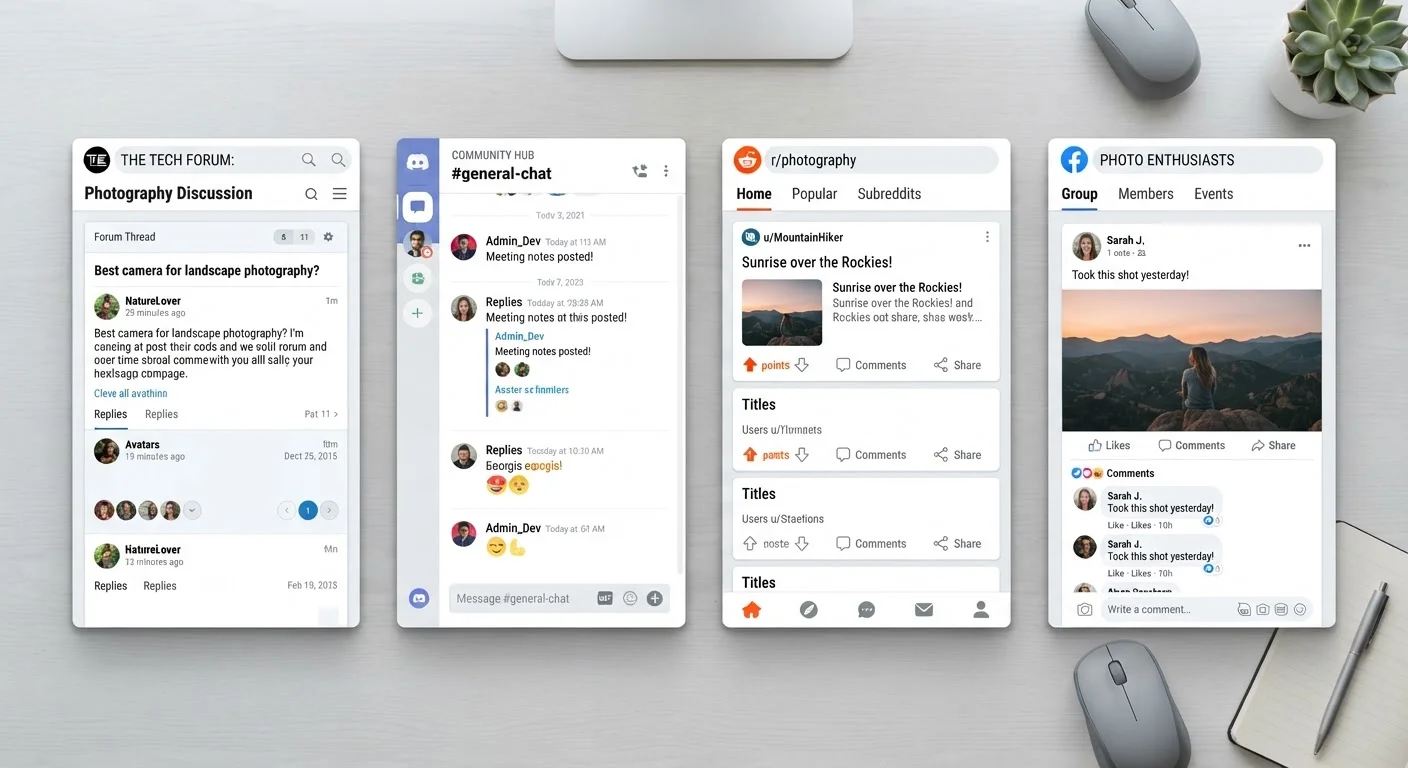
This comparison covers four of the most common community formats: traditional forums, Discord servers, subreddits (Reddit), and Facebook Groups. Each has genuine strengths - and real limitations.
Traditional Forums: Depth and Permanence
Standalone forums - think phpBB, XenForo, or community boards hosted on a dedicated site - organize conversation into topic categories and threaded replies. Posts stay visible and searchable for years, which makes them valuable as reference libraries. Someone asking a question today might find the answer in a thread from five years ago.
The trade-off is pace. Forums feel slow compared to chat-based platforms, and their interfaces can feel dated to newer internet users. Building an active forum from scratch also requires serious moderation infrastructure and sustained effort to maintain momentum. They work best for hobbyist communities with a need for organized, expert-level discussion - think woodworking, amateur radio, or tabletop gaming.
Start With the Content, Not the Platform
Before choosing a platform, write down how you expect members to use the space on a typical day. Will they ask questions and wait for answers? Have quick back-and-forth exchanges? Browse curated posts? Matching the expected interaction pattern to a platform's design will serve you better than picking whatever's most familiar.
Discord: Real-Time Community With Structure
Discord organizes communities into servers, each of which contains channels - text, voice, and video. It was built for gaming but has expanded into almost every interest area, from book clubs to professional networks. The key feature is immediacy: conversations happen in real time, and members can jump into voice or video with one click.
The limitation is that Discord's chat model makes older content hard to find. If someone asks a question and nobody's online, that question might scroll off the screen before it gets answered. Discord works best when a community is large and active enough that someone is usually around. It's also well-suited to communities that benefit from sub-groups - Discord's channel system allows fine-grained separation of topics within a single server. For communities organized around fan engagement, fan community hubs on Discord have become increasingly common.
Subreddits: Open Participation and Content Ranking
Reddit organizes communities into subreddits - topic-specific spaces where anyone can post and the community votes content up or down. The upvote/downvote system means popular content rises to the top, making subreddits effective for discovery: a well-placed post can reach thousands of people who weren't actively looking for it.
That same voting system shapes culture in complicated ways. Posts and comments that appeal broadly tend to win; nuanced or niche contributions can get buried. Anonymity is the norm, which lowers the social cost of participation but also reduces accountability. For a closer look at how Reddit and Facebook approach these structural trade-offs differently, see how subreddits and Facebook Groups compare.
| Forum | Discord | Subreddit | Facebook Group | |
|---|---|---|---|---|
| Conversation style | Threaded, asynchronous | Real-time chat | Post + comment threads | Post + comment threads |
| Content permanence | High - easily searchable | Low - scrolls away quickly | Moderate - archived but ranked | Low - algorithm filters |
| Anonymity | Varies by platform | Pseudonymous | Pseudonymous norm | Real identity typical |
| Discovery by outsiders | Moderate | Invite/link required | High via Reddit search | Limited, setting-dependent |
| Setup complexity | High | Moderate | Low | Very low |
| Best community size | Small to medium | Medium to large | Any size | Small to large |
Facebook Groups: Familiarity and Social Connection
Facebook Groups sit inside an existing social network, which means joining one requires no new account, no new app, and no learning curve. That accessibility makes them attractive for communities organized around real-world ties - local neighborhood groups, school alumni networks, hobby clubs, or family connections. Members often know each other offline, which changes the tone considerably.
The downsides are real. Facebook's algorithm controls what members actually see, so not every post reaches everyone. Privacy settings vary, but even private groups exist within Facebook's data ecosystem. And the platform's general-purpose design means Groups lack the specialized features that dedicated forum software or Discord offers. For communities that want to explore alternatives beyond these mainstream options, niche platforms worth knowing covers additional spaces worth considering.
Matching Platform to Purpose: A Practical Framework
Rather than asking which platform is best overall, ask what your community actually needs:
- Is the content meant to last? Forums and subreddits archive discussion better than Discord.
- Does the community need real-time interaction? Discord is purpose-built for it; the others are not.
- How important is discoverability? Subreddits surface content to non-members; the others are more closed by default.
- Are members starting from an existing social network? Facebook Groups reduce friction by meeting people where they already are.
- How much moderation capacity do you have? All four require active moderation, but the tools and demands differ significantly.
For a broader look at how all these community types compare side by side, this breakdown of online community formats goes into additional detail. You can also explore the full landscape of online platforms to understand where these community types fit within the wider digital ecosystem.