
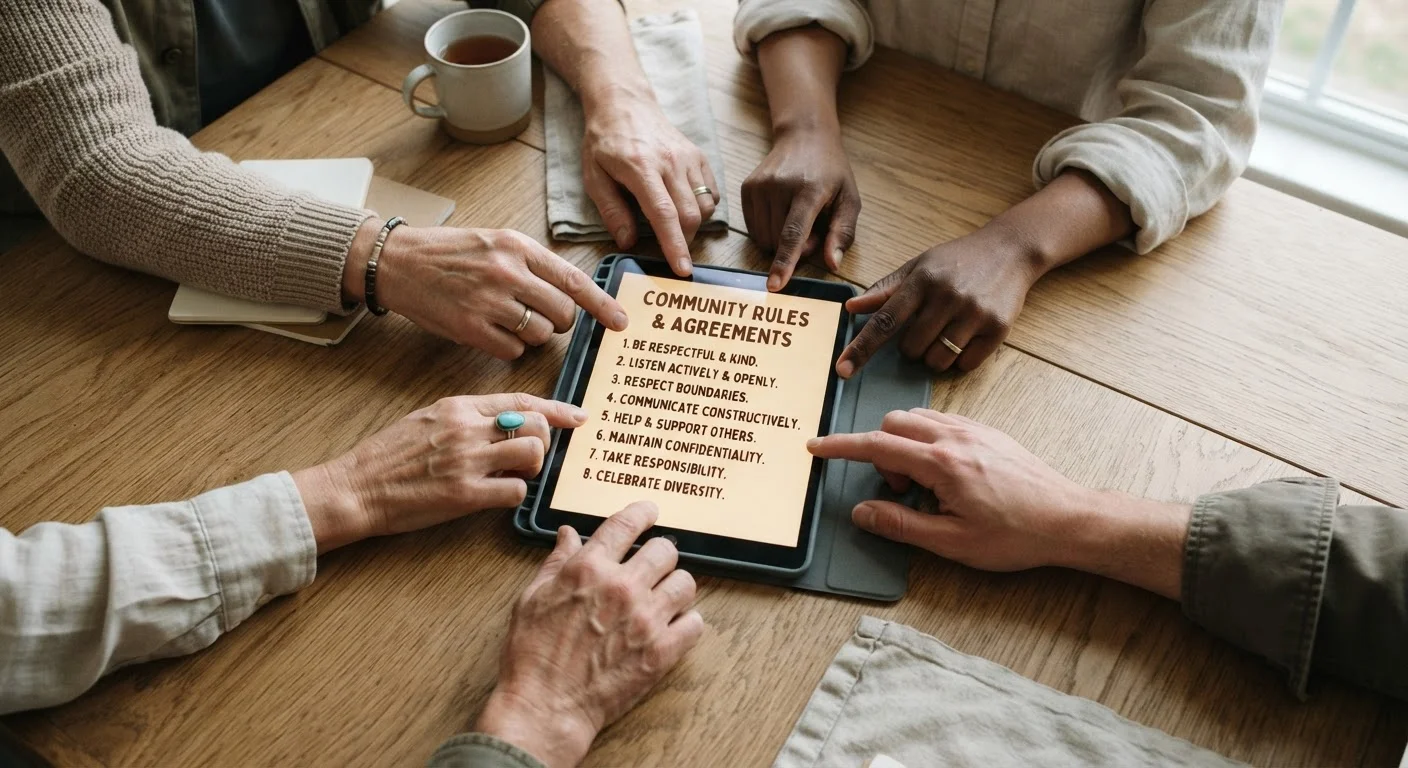
What Community Guidelines Actually Cover
Most community guidelines address a predictable set of concerns, even when the wording differs from one platform to the next. At a minimum, they typically cover:
- Prohibited content - hate speech, harassment, graphic violence, spam, and illegal material are common categories.
- Posting rules - requirements around staying on topic, using appropriate language, or formatting posts in a specific way.
- Interaction standards - how members are expected to treat one another, including rules against personal attacks or doxxing (revealing someone's private information without consent).
- Consequences - what enforcement looks like, from warnings to bans.
Some communities go further, detailing rules around self-promotion, sourcing claims, or even how to title a post. The scope reflects what the community's organizers believe needs to be spelled out to keep the space functional. You can explore how these written rules interact with informal behavior in our piece on norms and unwritten rules.
64%
Users who have witnessed online harassment
According to Pew Research Center survey data, a substantial majority of American internet users report having seen harassment directed at others online.
Top reason
Why users leave online communities
Research from the Online Community Report has consistently cited toxic behavior and poor moderation as primary drivers of community abandonment.
Millions
Pieces of content moderated daily on major platforms
Large platforms like Meta and YouTube process millions of content moderation actions each day, relying heavily on automated systems to handle volume.
Why Guidelines Exist - and Who They Protect
Guidelines serve three overlapping purposes: protecting individual members, protecting the community as a whole, and protecting the platform from legal and reputational risk.
For individual members, clear rules create a baseline of safety. Knowing that harassment is against the rules - and will be acted upon - makes people more willing to participate. Without that assurance, many users, particularly those from marginalized groups, simply disengage.
For the community, guidelines preserve purpose. A forum dedicated to amateur astronomy loses value if it fills up with off-topic arguments or commercial spam. Rules keep the signal-to-noise ratio manageable. This connects to the broader structure that holds communities together, which we break down in The Anatomy of an Online Community.
For platforms, guidelines reduce liability and satisfy legal obligations - particularly around content that could be considered illegal in certain jurisdictions. They also help platforms maintain advertiser relationships, which often depend on brand-safe environments.
“Moderation is not censorship - it is curation. Every community makes choices about what it is and what it is not, and rules are how those choices get made explicit.”
— Cliff Lampe, Professor of Information Science, University of Michigan, and researcher on online community design
How Enforcement Actually Works
Reading a list of rules is one thing. Understanding how those rules get applied is another. Enforcement typically involves a combination of automated systems and human moderators.
Automated tools flag posts that match known patterns - links to prohibited sites, certain keywords, or image hashes linked to illegal content. These systems act fast but make mistakes, sometimes removing content that doesn't actually violate any rule.
Human moderators - who may be paid staff on large platforms or volunteers in smaller communities - review flagged content, respond to reports from other users, and make judgment calls in ambiguous cases. Moderation is time-consuming and often thankless work, which is why many smaller communities struggle to keep up with it.
When a violation is confirmed, the response depends on its severity and the member's history. A first-time, borderline offense might result in a removed post and no further action. Repeated or serious violations typically escalate. Most platforms offer some form of appeal, though the process can feel opaque from a user's perspective. For a broader look at how platform-level policies shift over time, see why platforms keep changing their rules.
How to Read Guidelines Before You Post
Most people skip community guidelines entirely - until they get a warning or a post removed. A few minutes of upfront reading can prevent that friction. Here's a practical approach:
- Find the rules before you engage. Look for a sidebar, pinned post, or "About" page in the community. Platform-wide guidelines are usually linked in the site footer.
- Look for community-specific additions. Platform rules set a floor; individual communities often add their own requirements on top. Both apply to you.
- Pay attention to what's defined. Guidelines that define terms like "spam" or "harassment" specifically are more useful than vague ones. Knowing exactly what counts helps you stay on the right side of the line.
- Note the enforcement process. Does the community explain how to appeal? Is there a way to report violations? This tells you how seriously the rules are taken.
Engaging thoughtfully from the start is one of the core habits outlined in our guide to healthy online community participation.
A user joins a subreddit about personal finance and posts a link to their own YouTube channel. The post is removed within minutes.
A commenter on a news discussion forum responds to a disagreement with insults directed at another user. Their comment is deleted and they receive a 24-hour suspension.
A member of a neighborhood Facebook group posts a political argument unrelated to local issues. The post is removed by an admin.
A new forum participant posts the same question in five different topic threads to maximize visibility.