The Basic Breakdown: Three Kinds of Participants
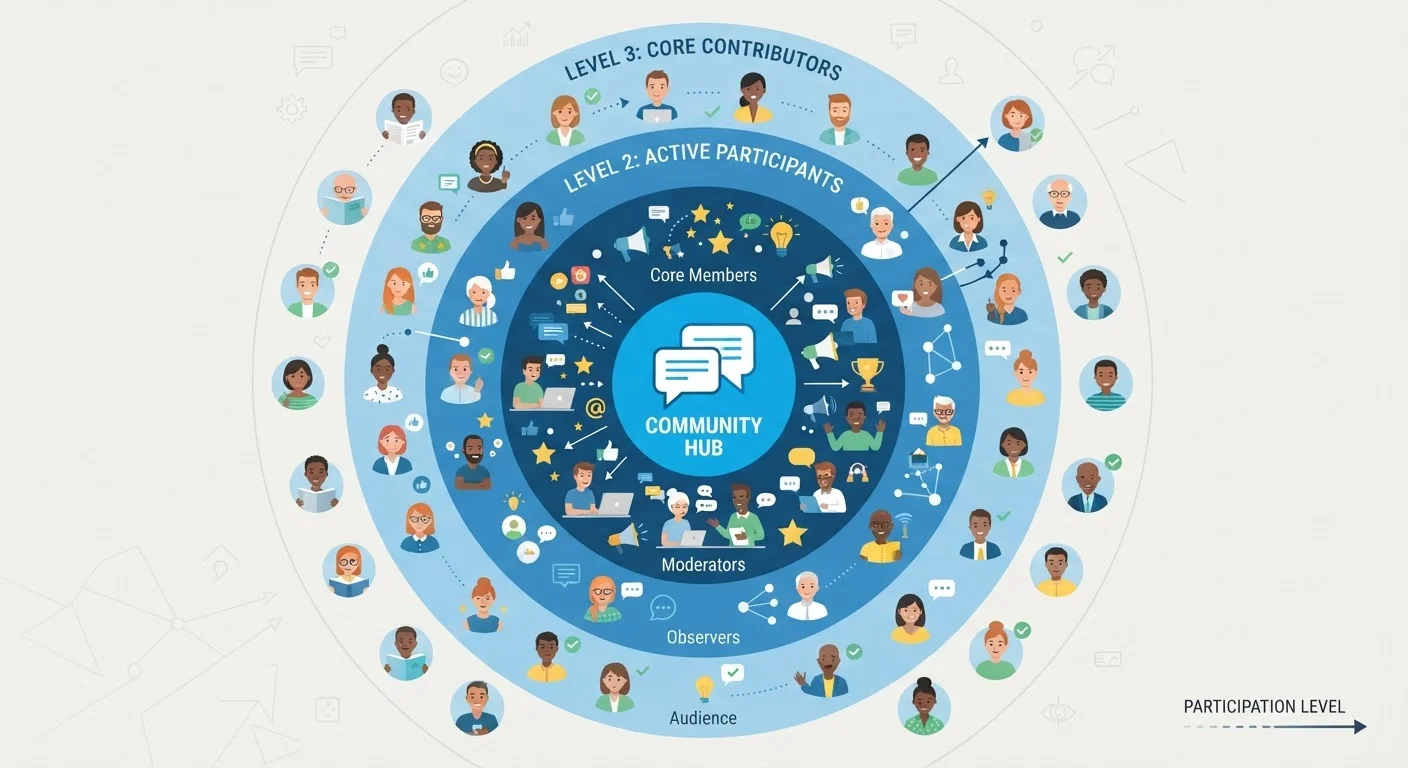
Walk into any online community-a subreddit, a Discord server, a Facebook Group, a niche forum-and you'll find the same broad cast of characters. Most people fall into one of three categories: lurkers, contributors, and moderators. Understanding who does what helps explain why communities feel the way they do, and how they stay alive or fall apart.
| Most common participant type | Lurkers (passive readers) (90-9-1 participation pattern, widely cited in online community research) |
| Who sets community rules | Moderators, often volunteer members |
| Who generates visible content | Contributors (posts, comments, votes) |
| Typical moderator compensation | Unpaid volunteer in most communities |
| Where platform rules apply | Across all communities on a given platform |
For a wider look at the platforms where these dynamics play out, see our overview of the major types of online communities.
Lurkers: The Silent Majority
Lurkers are members who read, watch, or listen without posting or commenting. They are far more common than most people assume. Research on online participation has repeatedly found that a small fraction of members produce most visible content-a pattern sometimes called the 90-9-1 rule, where roughly 90% of users only observe, 9% contribute occasionally, and 1% account for the bulk of posts.
Lurking is not passive in a negative sense. Lurkers absorb information, form opinions, and often return regularly. They expand a community's reach by reading without adding noise. Many active contributors started as lurkers-building enough familiarity and confidence before they ever posted.
For a deeper look at what separates lurking from participation, see the difference between reading and engaging online.
Contributors: The People Who Keep Conversations Going
Contributors are anyone who adds something visible-a post, a comment, a question, a vote, a shared link. This group spans a wide spectrum. Some contributors post daily; others show up a few times a month. Some are recognized experts; others are newcomers sharing a first experience.
Within the contributor category, informal roles tend to emerge over time: the person who always welcomes newcomers, the one who answers technical questions, the critic who challenges ideas, the creator who generates original content. These patterns are not assigned-they develop organically. Our article on roles that naturally emerge in online communities covers these informal types in detail.
Lurker
A community member who reads or observes without posting or commenting. Lurkers make up the majority of most online communities and contribute to a community's reach without adding visible content.
Contributor
Any member who adds visible content-posts, comments, votes, or shared links. Contributors range from occasional participants to highly active regulars who shape community culture.
Moderator (Mod)
A member with elevated permissions to enforce community rules. Moderators can remove posts, ban users, and manage disputes. In many communities they are unpaid volunteers.
90-9-1 Rule
A rough pattern observed across many online communities where about 90% of members only observe, 9% contribute occasionally, and 1% produce the majority of content. It is a descriptive pattern, not a fixed law.
Platform Moderation
Content oversight conducted at the platform level-by the company that runs the service-through automated systems and human reviewers. This is separate from and sits above community-level moderation done by volunteer mods.
Contributors are the engine of community culture. Without them, there is nothing for lurkers to read and nothing for moderators to manage.
Moderators: The People Who Keep Things Functional
Moderators-often called mods-are members with elevated permissions to enforce community rules. On most platforms they can remove posts, ban users, pin important content, and resolve disputes. In many communities, moderators are unpaid volunteers drawn from the contributor base.
Their work is less about control and more about maintenance. A community without moderation tends to drift toward spam, harassment, and off-topic noise-conditions that drive members away. Good moderation is largely invisible: when it works well, members rarely notice it.
Platform-level moderation-automated filters, content review systems, and the policies set by the platform itself-is a separate layer that sits above community-level mods. Our article on how content moderation works across major platforms explains how those systems function.
Why the Mix Matters
A healthy community generally needs all three types. Lurkers provide an audience that gives contributors a reason to post. Contributors generate the content and relationships that make a community worth joining. Moderators set the conditions that allow both groups to participate without the space deteriorating.
The balance shifts by platform and topic. Tightly focused communities-say, a support group for a specific medical condition-often have higher rates of active participation than large general-interest forums. Platform structure influences participation style in ways that matter.
Understanding these roles also helps if you're deciding how to engage. You don't have to post to belong. But knowing the roles can help you find your place more intentionally-whether you're just starting to observe or thinking about contributing more. For background on what holds communities together in the first place, see what makes a group of people an online community.