Why This Choice Matters for Your Creative Growth
Every creative hobbyist faces a quiet decision early on: do you build your practice in private, or do you bring others into it? The answer shapes not just your skill development but your relationship with the work itself. As explored in our practical primer for new creative hobbyists, finding your footing in a creative art involves more than picking a medium - it involves understanding how you learn and stay motivated.
This isn't about introversion versus extroversion. Plenty of socially outgoing people do their best creative work alone, and many self-described loners find group critique sessions energizing. The question is more specific: what does each environment actually do to your creative development, and how do you choose intentionally?
What Solo Practice Develops
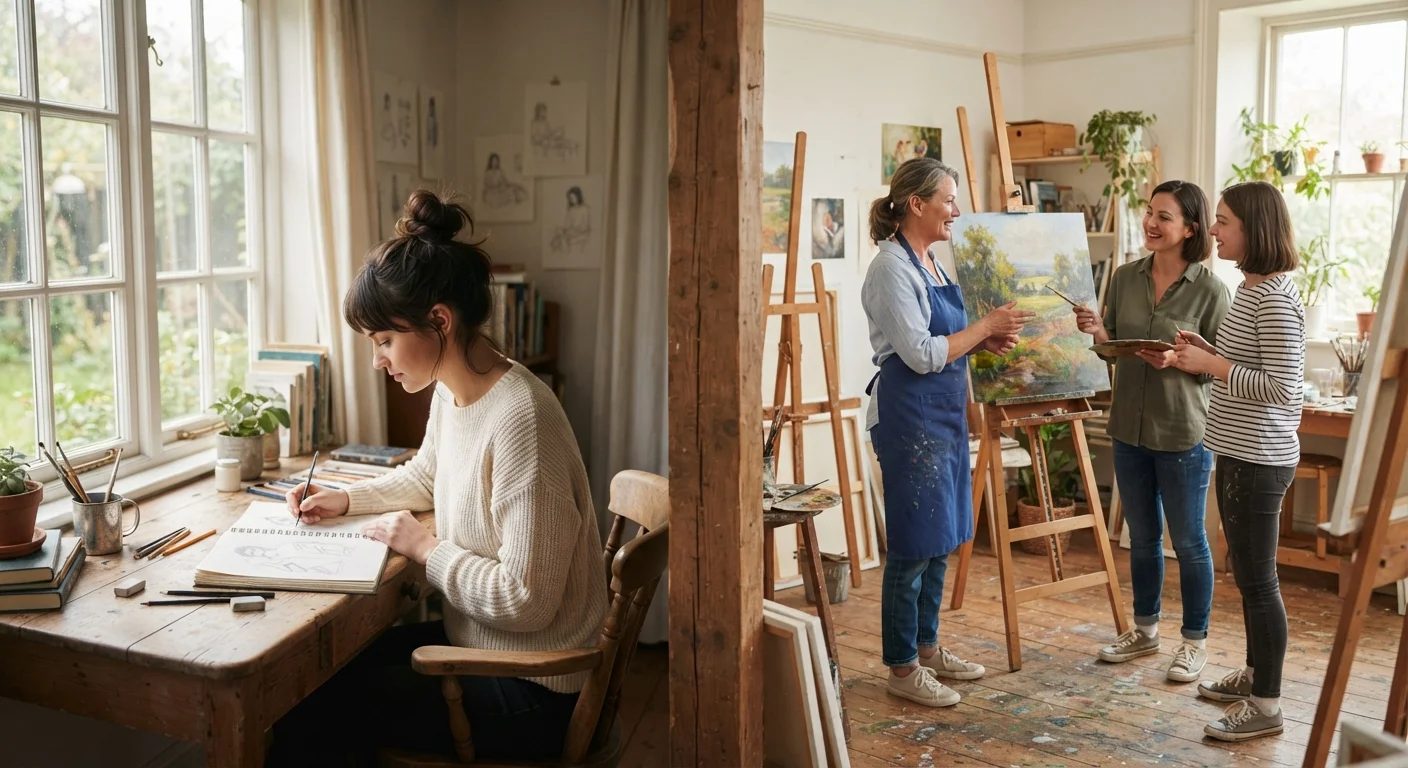
Working alone removes the social layer from the creative act. That absence is both a gift and a limitation. Without an audience - even a small, informal one - you're free to experiment in ways that might feel too risky to share. Early drafts can be genuinely rough. You can abandon a piece halfway through without explanation. This psychological safety is one reason many hobbyists describe solo sessions as their most honest creative time.
Solo practice also builds what researchers sometimes call intrinsic motivation - the internal drive to create that doesn't depend on external validation. When no one is watching, you learn to become your own audience, which is a critical skill for sustaining a long-term hobby. Our guide on building a creative practice that actually sticks emphasizes that consistent, self-directed sessions are often the foundation of lasting creative habits.
The challenge with solo-only practice is that blind spots accumulate. Without outside perspective, you may repeat the same techniques, unknowingly reinforce errors, or plateau without realizing it. Progress can slow - not from lack of effort, but from lack of contrast.
Try Structured Solo Sessions
If you practice alone, introducing self-imposed constraints - a time limit, a specific prompt, or a technique you've never tried - can replicate some of the productive pressure that group environments create. Constraints push you outside habitual patterns without requiring an audience. Even photographing your work periodically and reviewing it later acts as a form of self-critique that builds the observational skills you'd otherwise develop through peer feedback.
What Creative Communities Offer
Joining a creative community - whether an in-person workshop, an ongoing critique group, or an active online forum - introduces variables that solo work simply cannot replicate. Chief among them is feedback. Hearing how others interpret your work, what reads clearly and what doesn't, accelerates learning in ways that self-evaluation rarely matches. You also gain exposure to approaches you might never have tried alone.
Accountability is another real benefit. When you've committed to sharing a piece at next week's meeting or posting to a group challenge, you're more likely to sit down and do the work. This is especially useful for hobbyists who struggle with consistency. The social dimension of group participation also tends to reduce the isolation that can accompany a solitary practice - something covered in depth in our piece on the social science behind solo and group hobbies.
That said, group environments carry their own risks. Social comparison can become discouraging, especially early in a hobby. The desire to impress or conform to group taste can narrow your creative range rather than expand it. How you participate matters as much as whether you participate.
| Solo Practice | Creative Community | |
|---|---|---|
| Creative freedom | High - no external expectations | Moderate - group norms can influence |
| Feedback quality | Limited to self-assessment | Regular, diverse external perspectives |
| Accountability | Self-generated only | Built-in through shared commitments |
| Skill plateau risk | Higher without external input | Lower due to contrast and challenge |
| Social connection | Minimal | Strong, with shared creative interest |
| Scheduling flexibility | Complete flexibility | Depends on group structure |
| Exposure to new techniques | Limited to self-directed research | Frequent through peer observation |
Finding the Right Balance for You
Most experienced hobbyists don't treat this as an either/or choice - they move between modes depending on the project, their energy, and where they are in their development. A useful starting point: use solo sessions for initial exploration and risk-taking, and bring work to a group once you've developed it enough to discuss meaningfully.
If joining a local group feels like too much of a commitment, online communities offer a lower-stakes entry point. Participating in a monthly challenge, posting work-in-progress in a forum, or lurking in a community before contributing are all valid ways to gain the benefits of group participation on your own terms. Our hub on effective online community participation has practical guidance for getting started without feeling overwhelmed.
Before committing significant time or resources to either path, it's worth doing some honest self-assessment. Our guide on picking up a new creative hobby wisely walks through how to evaluate your learning style and goals before diving in - advice that applies equally to choosing your practice environment.