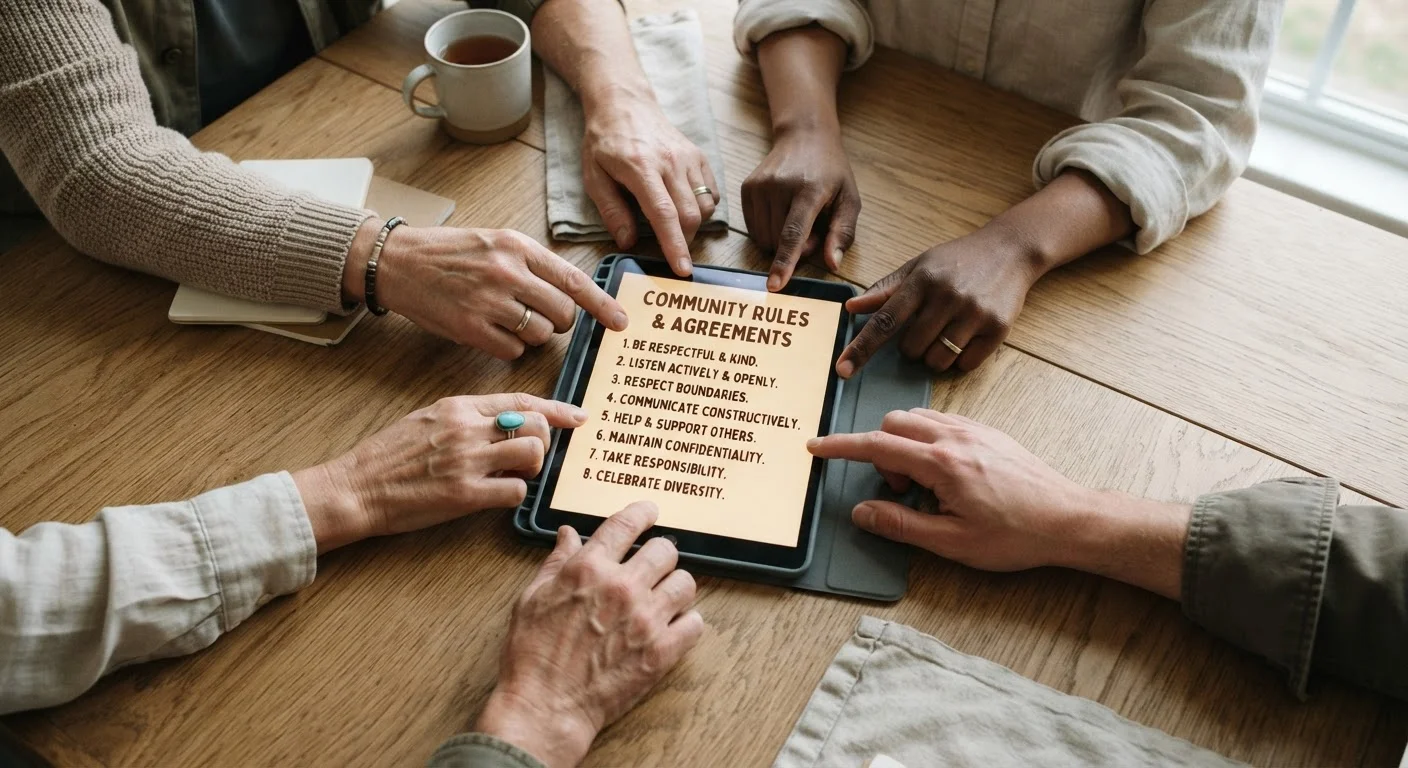

What Norms Actually Are in an Online Context
When you join an online community - a subreddit, a Discord server, a Facebook group, a forum - you're entering a space that already has an established culture. Some of that culture is visible in pinned rules. Most of it isn't written down anywhere.
Community norms are the expectations members hold about acceptable behavior. They cover everything from how you introduce yourself, to whether humor is welcome, to how strongly you're allowed to disagree. They exist in every community, whether anyone has bothered to articulate them or not.
It helps to understand that norms operate on two levels. The first is formal: official guidelines posted by administrators or moderators. The second is informal: the unspoken standards that members enforce through social feedback - upvotes, replies, callouts, or silence. Both matter, but the informal layer often has more day-to-day influence on how a community actually feels. For a deeper look at the structure behind these dynamics, see how online communities are structured.
Formal Rules vs. Community Culture
It's worth distinguishing between a community's official guidelines and its actual culture. Guidelines set the floor - the minimum required behavior. Culture sets the ceiling: what members expect, reward, and identify with. A space can technically follow its own written rules while still feeling unwelcoming if the informal culture goes in a different direction. For a closer look at how official guidelines work, see what community guidelines are designed to do.
Why Norms Differ So Dramatically Across Communities
The most common question newcomers face is simple: why is something totally fine in one space but a bannable offense somewhere else? The answer lies in how norms form in the first place.
Purpose shapes everything. A community built around professional development will naturally develop norms around respectful discourse and credibility. A community built around satire or memes will tolerate - even reward - behavior that would look disruptive in more serious spaces.
Early members set the tone. Research on group behavior consistently shows that the culture established in a community's early days tends to stick, even as membership grows. If the founding members rewarded long, detailed posts, that expectation often persists long after those founders have moved on.
Platform architecture matters too. A community on a platform with anonymous accounts will develop different norms than one where members use their real names. Upvoting systems, character limits, and moderation tools all nudge behavior in particular directions - often without anyone explicitly deciding to create a norm. This is part of why what defines an online community goes beyond just having members in one place.
77%
Americans who have used online groups or forums
A Pew Research Center survey found that a large majority of U.S. adults have participated in some form of online group, highlighting how widespread community participation has become.
~2/3
Online community conflicts traced to unclear norms
Community management research consistently identifies ambiguous or unenforced norms as a leading cause of member conflicts and drop-off in online groups.
1 in 3
Users who left a community due to toxic behavior
Surveys of online community participants regularly find that roughly a third of respondents have abandoned at least one community because of hostile or unwelcoming behavior from other members.
How Norms Are Enforced - With and Without Moderators
Formal enforcement - warnings, post removals, bans - is the visible part. But communities also regulate themselves through subtler mechanisms that don't require any moderator involvement at all.
Peer feedback is the most common. When a post gets ignored while similar ones thrive, that's normative pressure in action. When members respond to an off-topic comment with a gentle redirect, they're reinforcing expectations without anyone invoking official rules. Over time, this kind of social correction shapes what members believe is appropriate even before they've read any written guidelines.
This self-regulation is closely related to what researchers call netiquette - general courtesy principles that apply broadly online - but community norms go further by being specific to a particular group's history and values. How communities self-regulate through informal norms explores this distinction in more depth.
Understanding enforcement helps explain why violating an unwritten rule can sting more than breaking a posted one. Written rules feel external and institutional. Unwritten norms feel like a community's identity - and crossing them can feel like a social rejection rather than just a policy violation.
What This Means for Anyone Joining a New Community
Knowing that norms exist - and that they vary - puts you in a better position to participate without unnecessary friction. The practical implication is simple: slow down before you dive in.
Reading through recent posts before contributing is the most reliable way to absorb a community's actual culture. Notice what kinds of comments get positive responses and which ones seem to land flat or generate pushback. Look at how members address each other and whether insider language or references appear frequently.
Written rules are worth reading, but they're only part of the picture. Picking up on the subtler signals that reveal a community's real culture requires a different kind of attention than just scanning a pinned post. Meanwhile, keep in mind that norms shift - especially in communities that are growing or going through changes driven by platform policy updates.
No community is perfectly consistent, and most have some tolerance for newcomers who are clearly making an honest effort to fit in. The goal isn't to be a perfect participant from day one - it's to approach each space with enough awareness to learn its rules before testing them.
Observe Before You Post
When joining any new online community, spend time reading existing conversations before contributing. Pay attention to the length, tone, and format of posts that receive positive responses. This 'lurking' period - often just a few days - significantly reduces the chance of an unintentional norm violation.